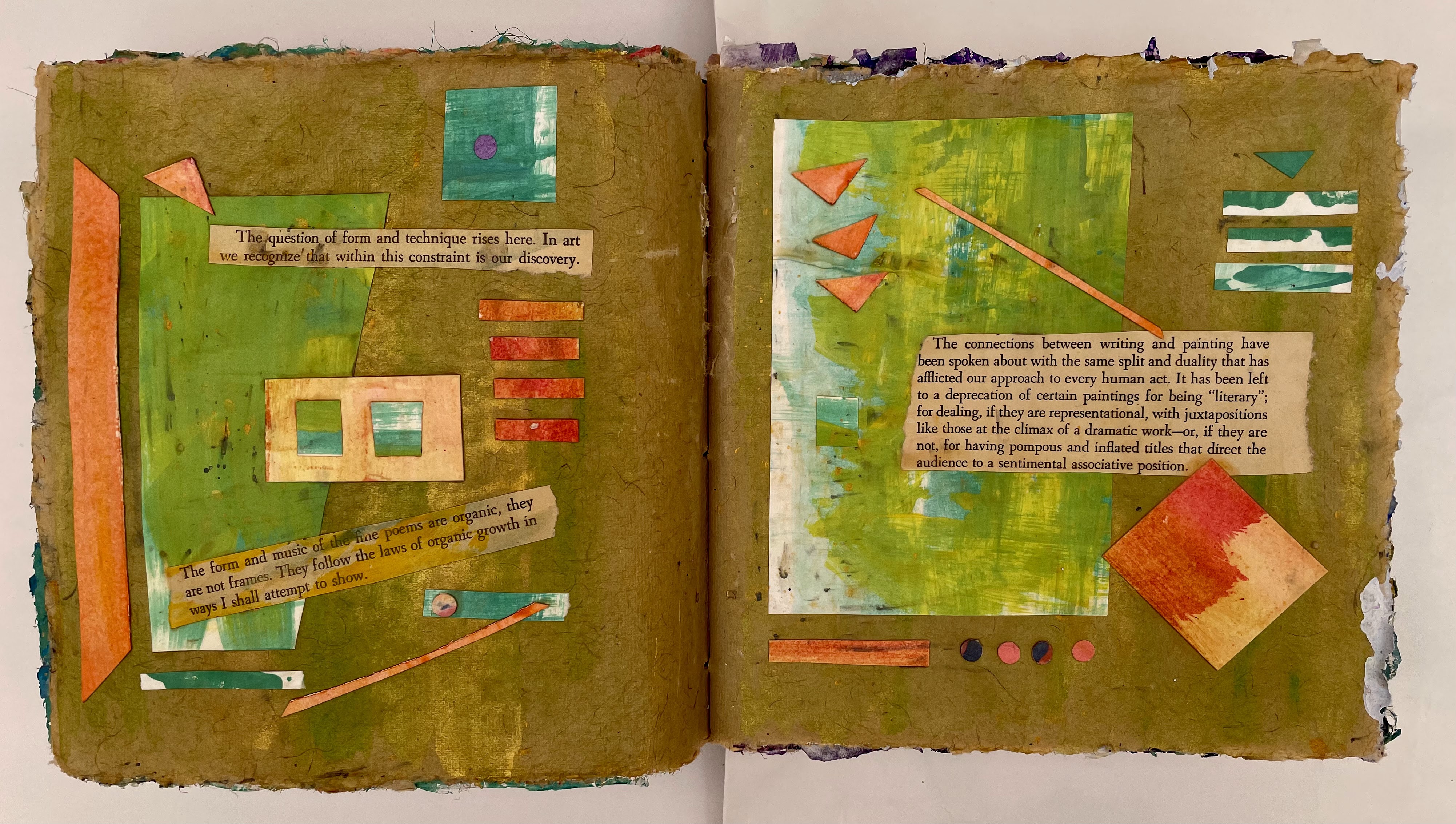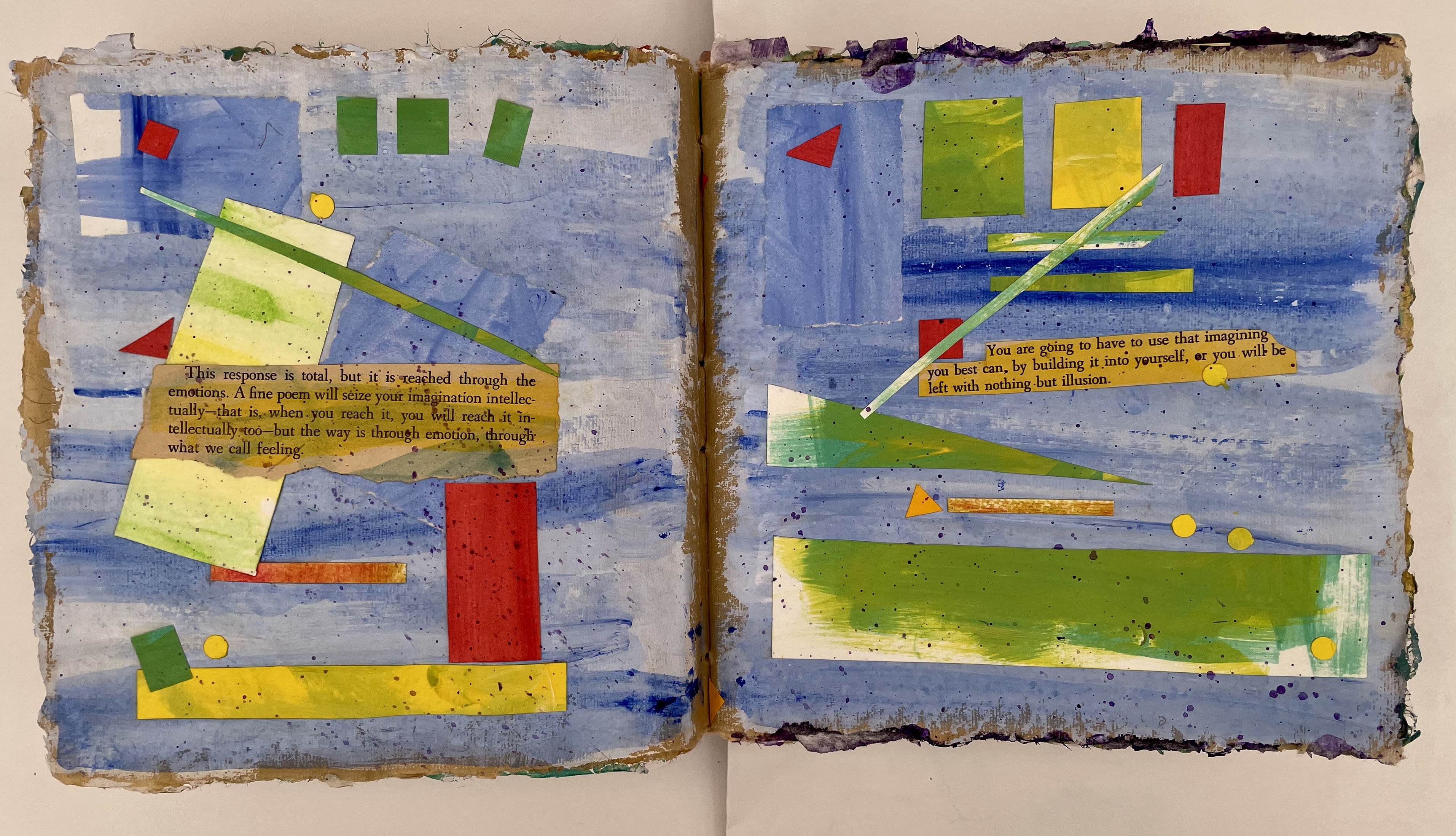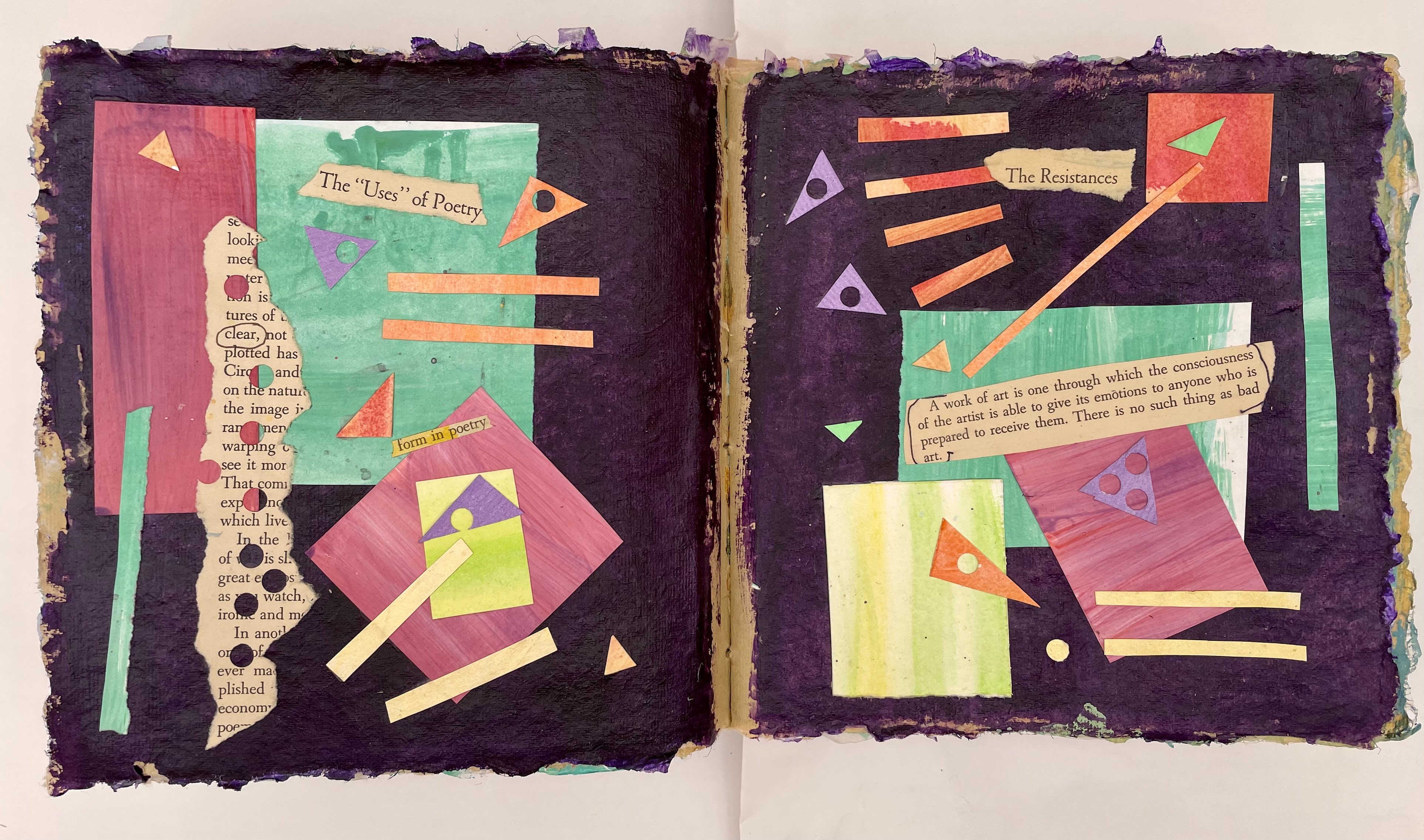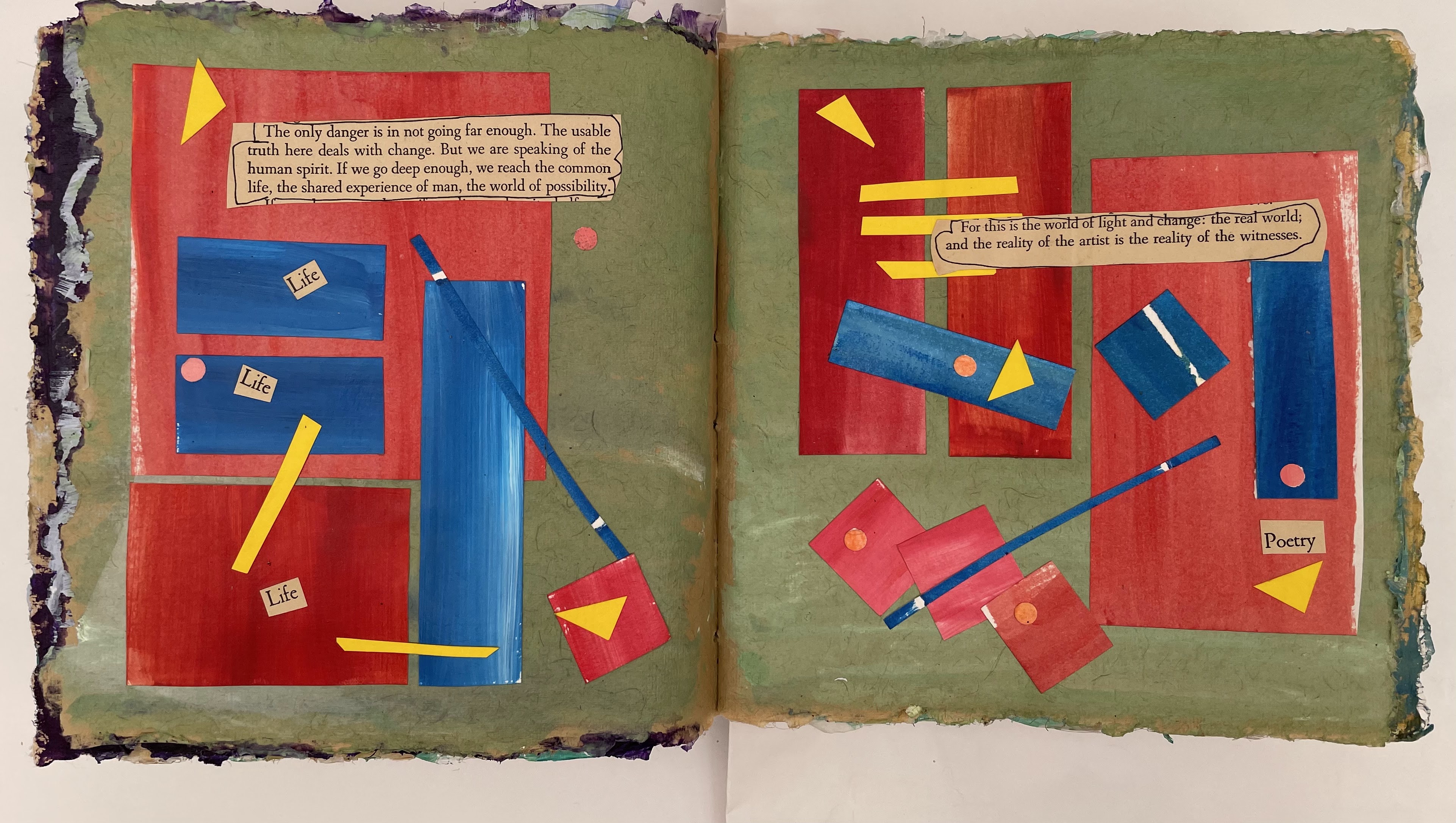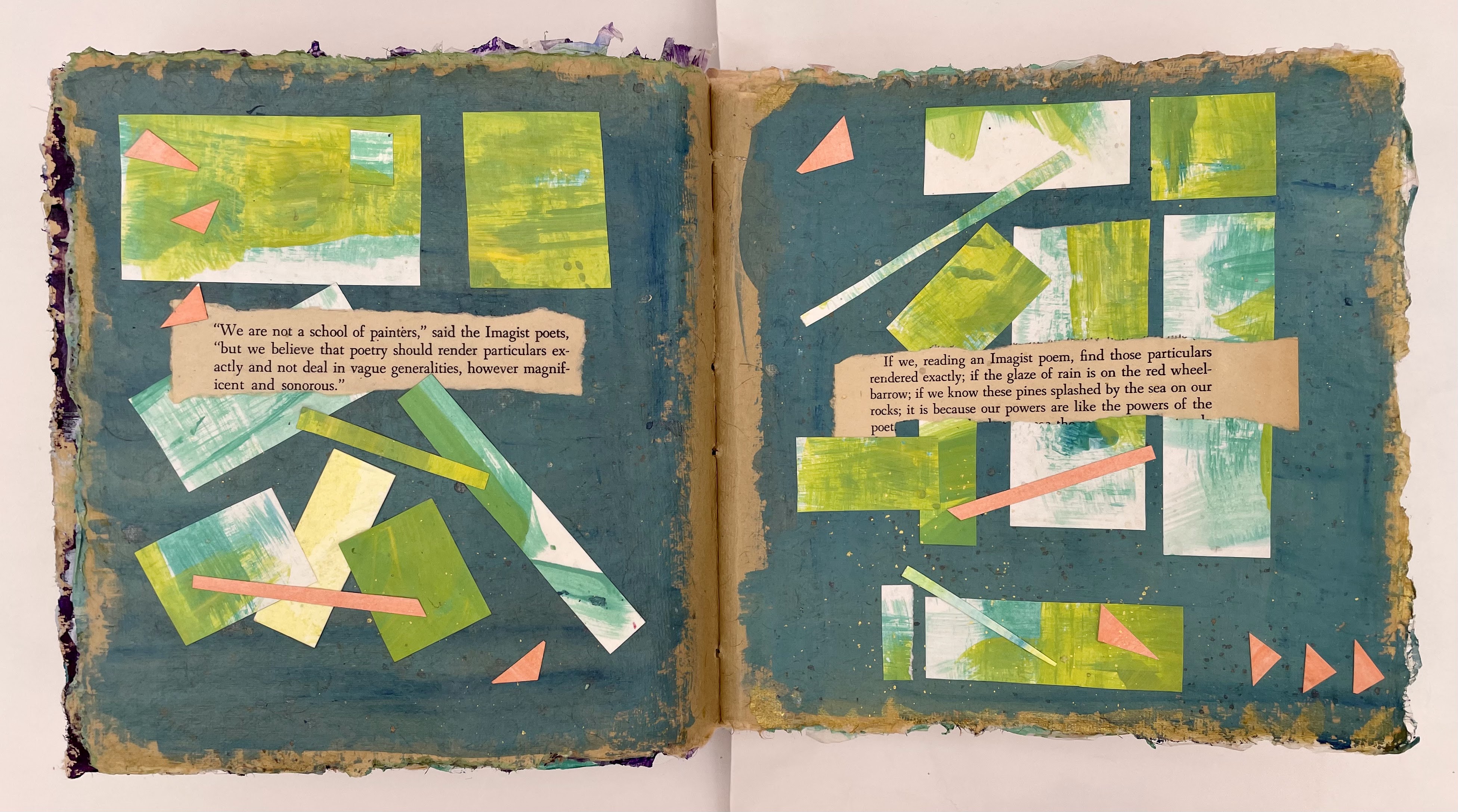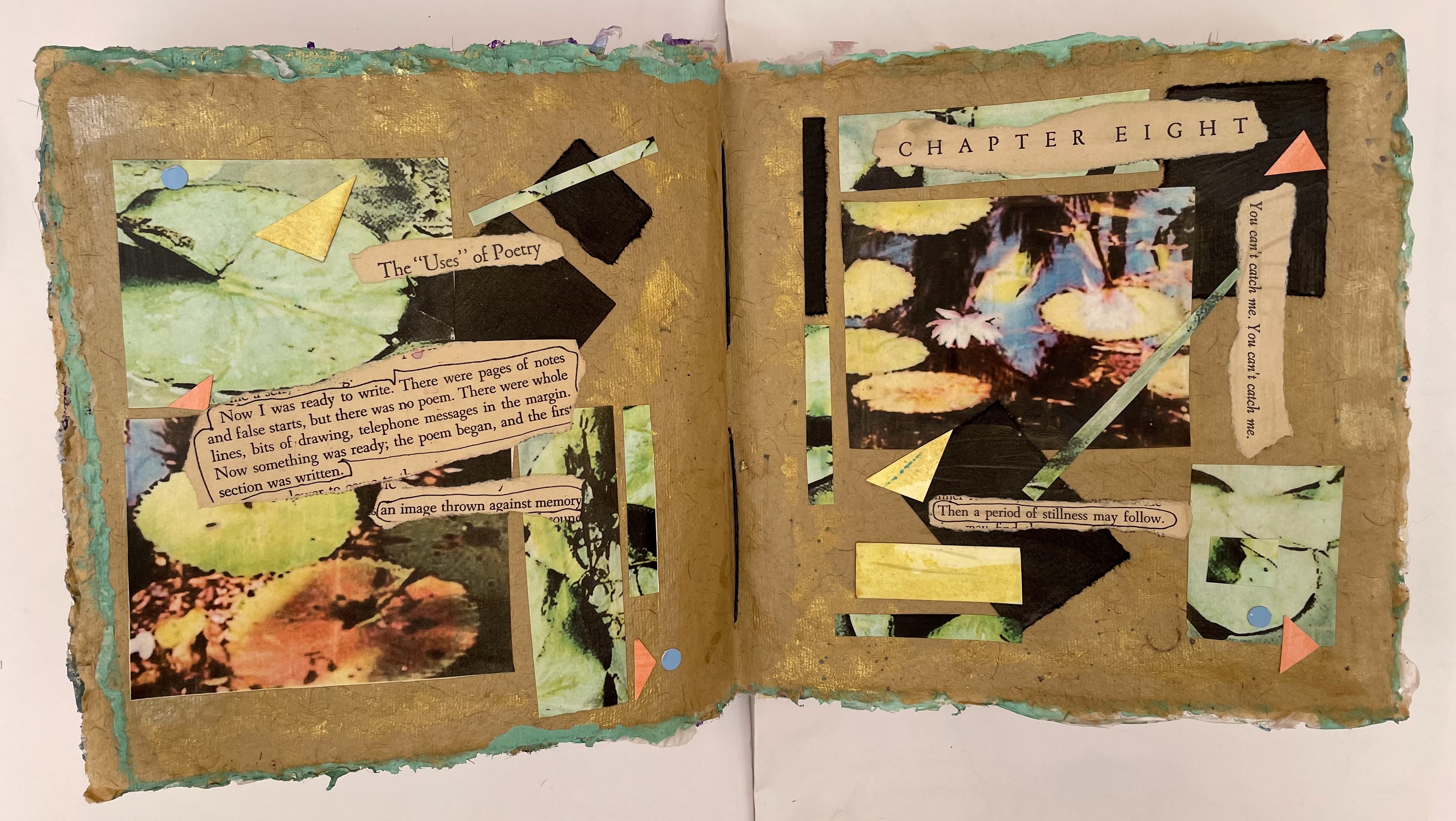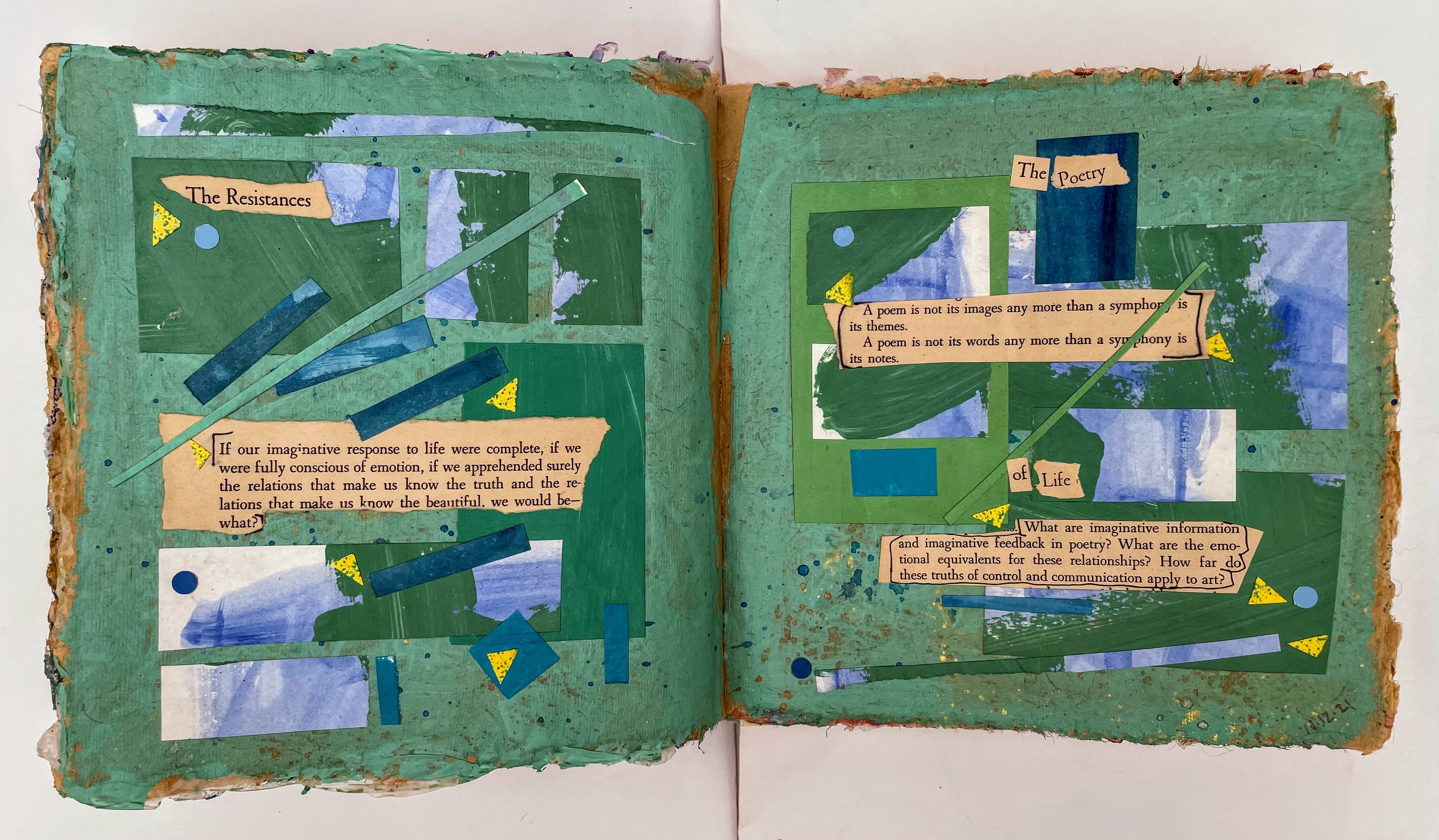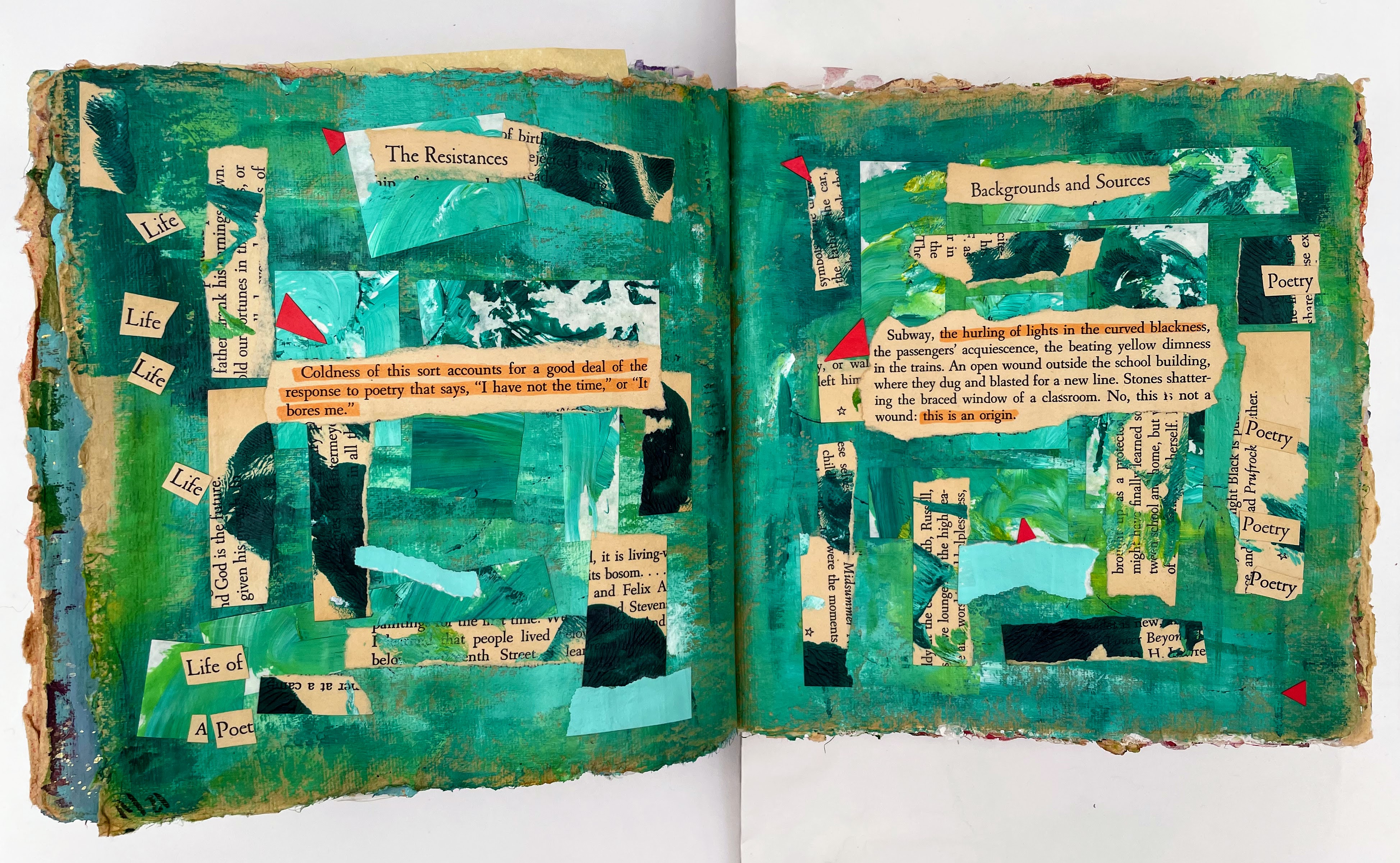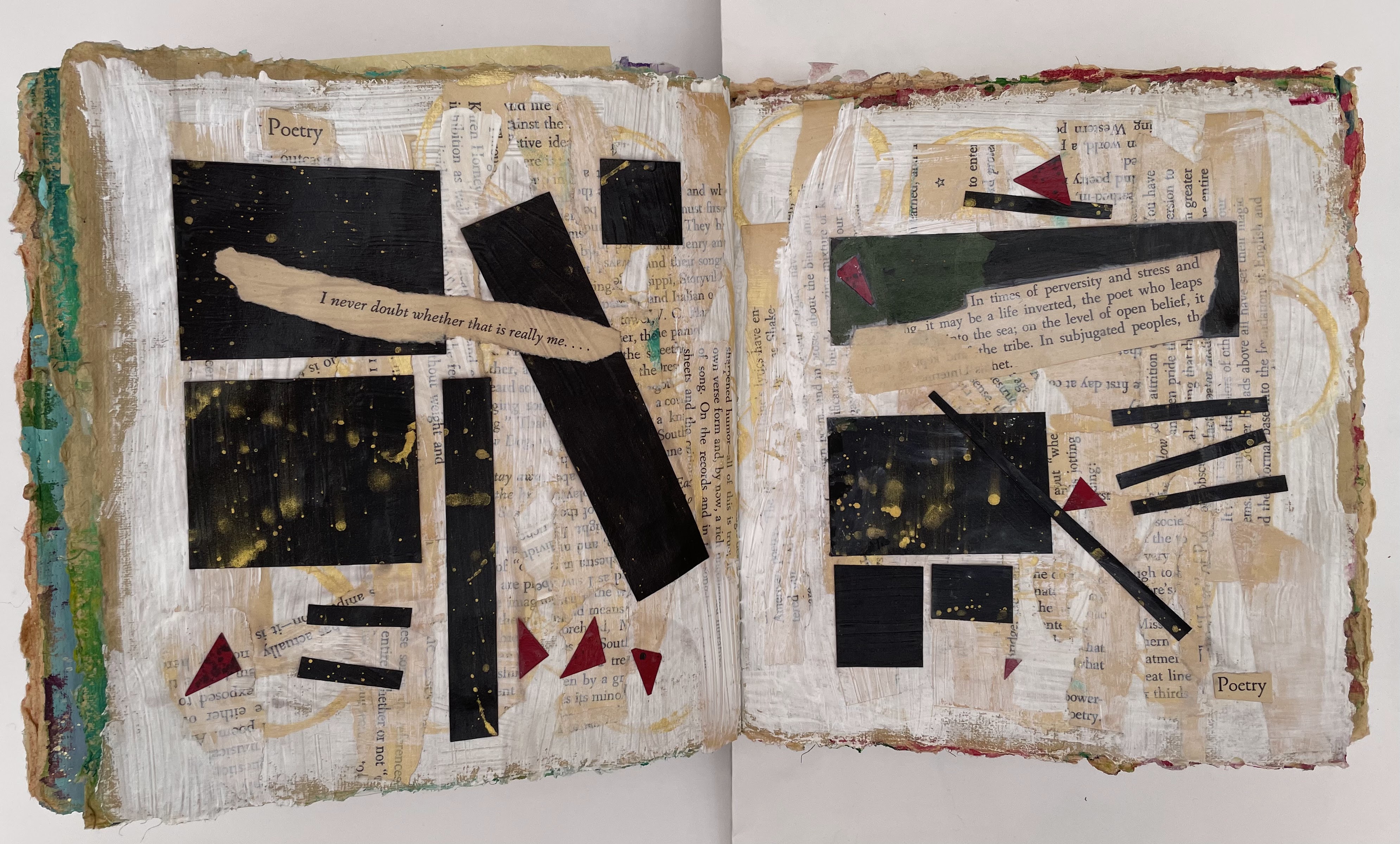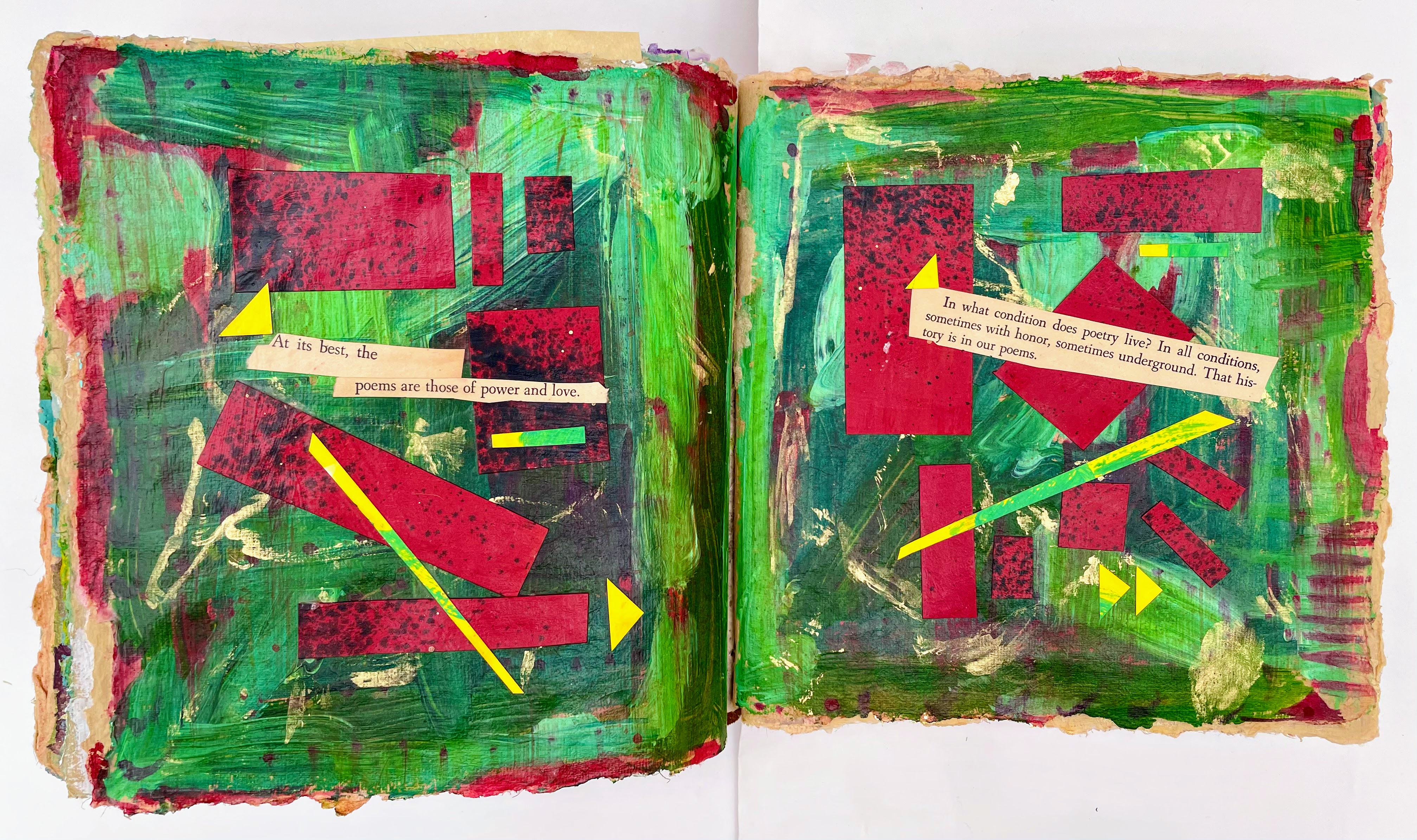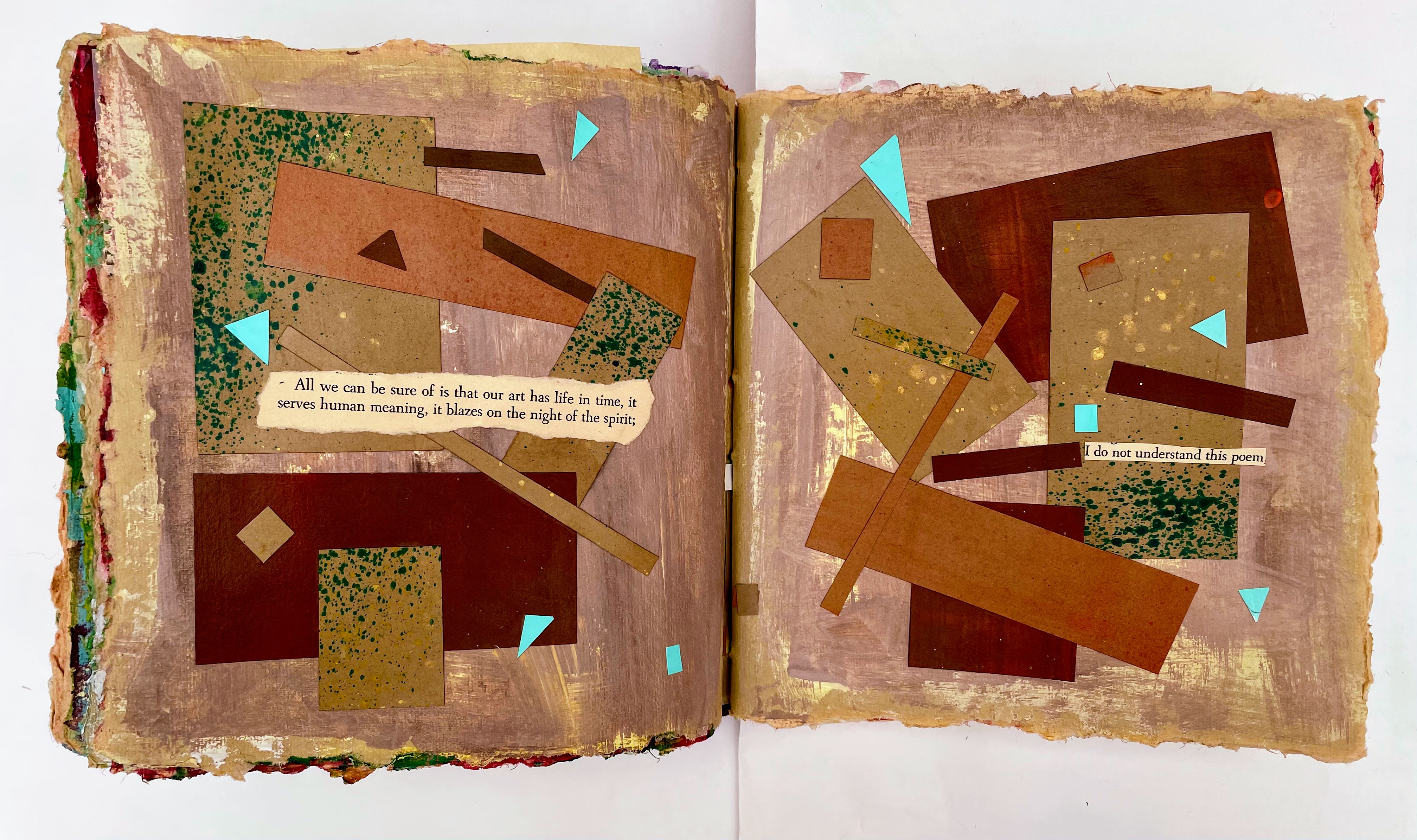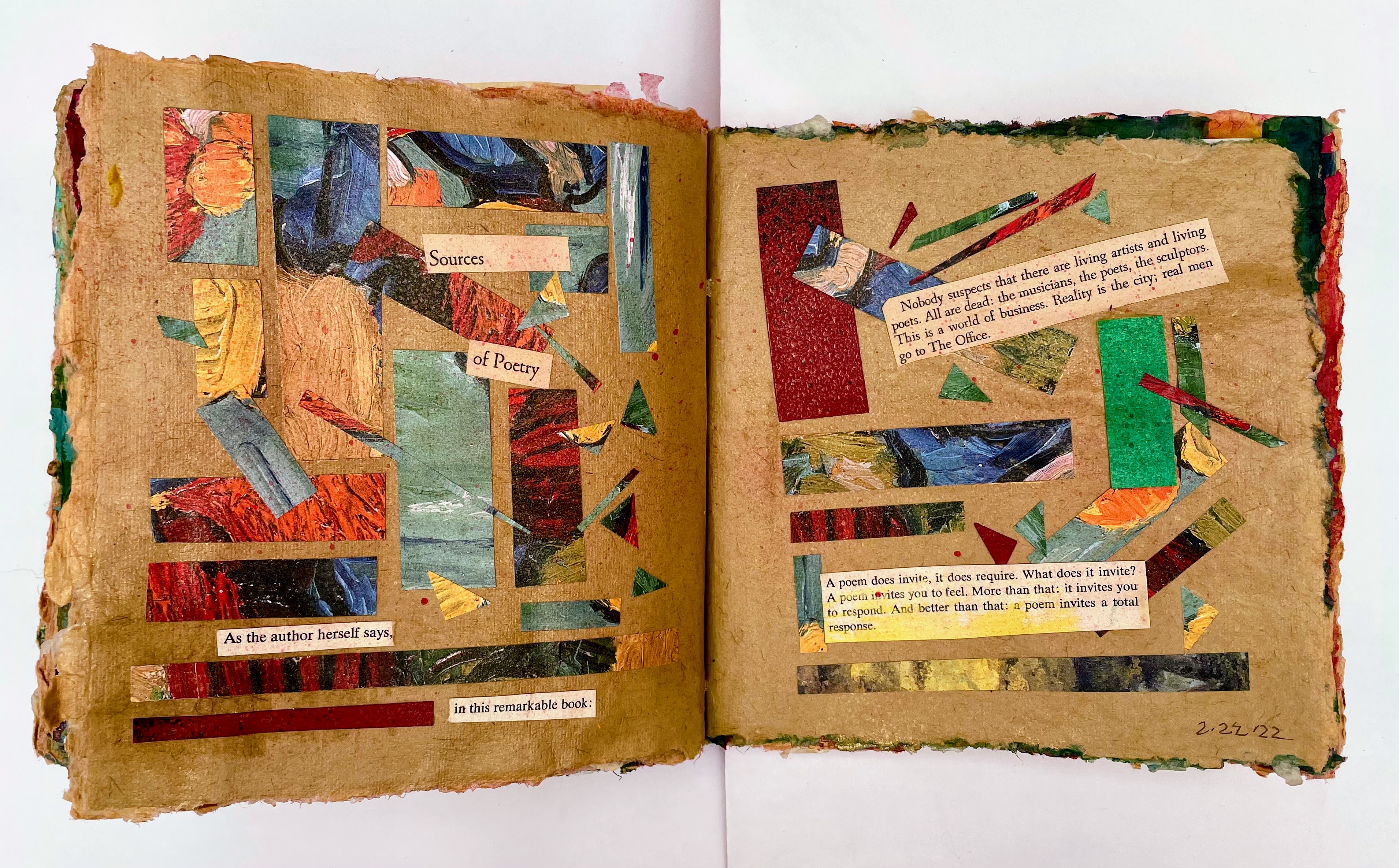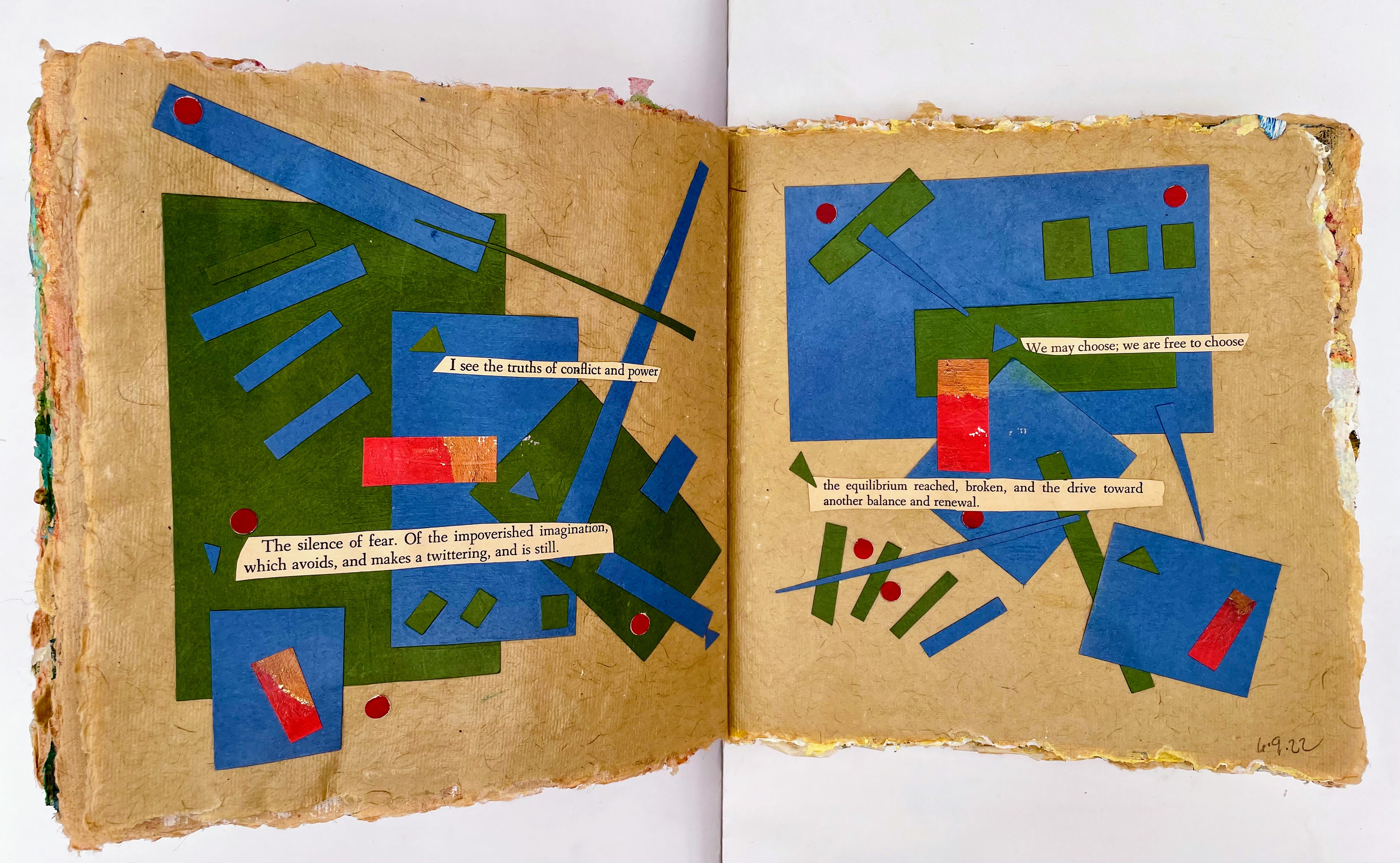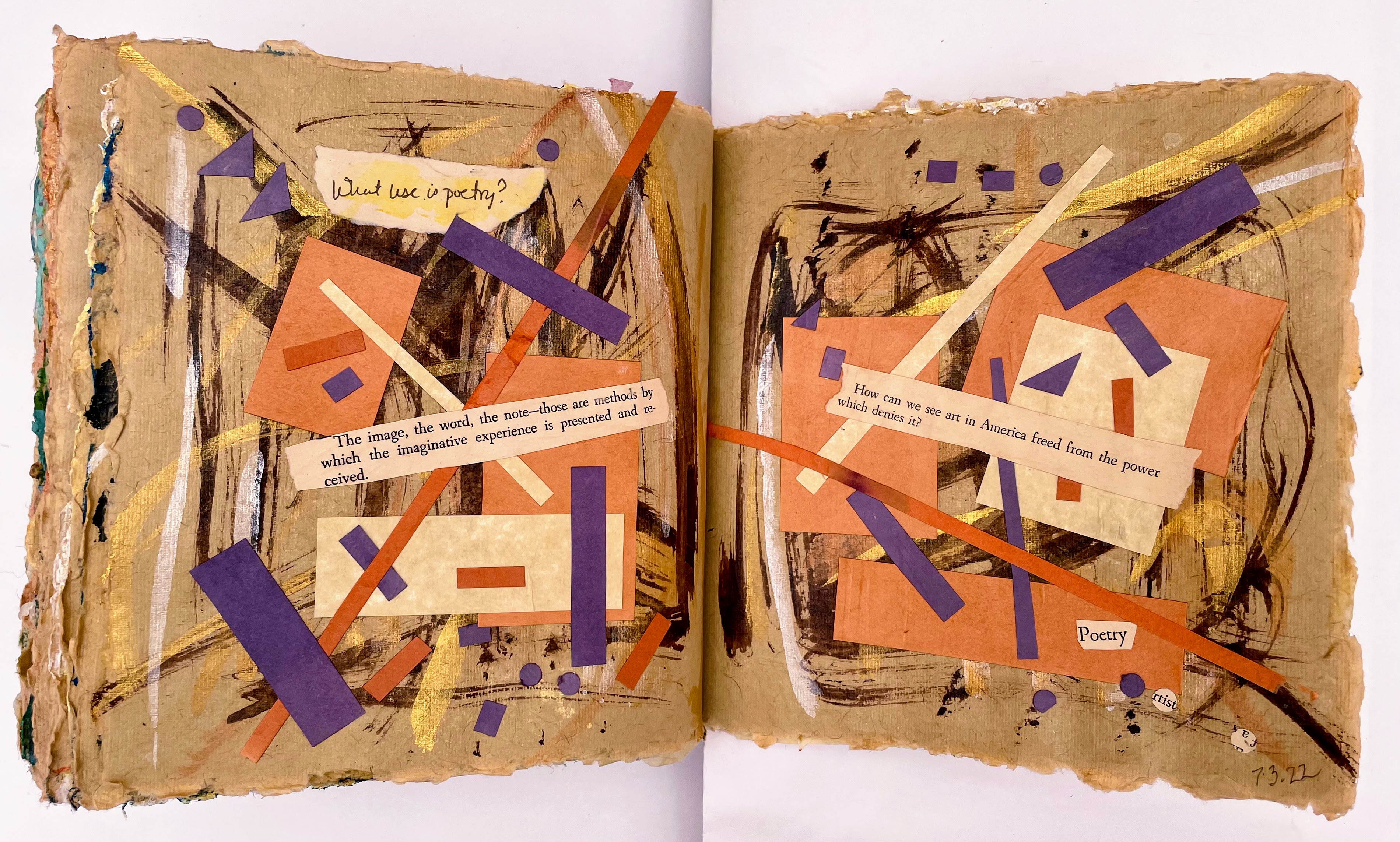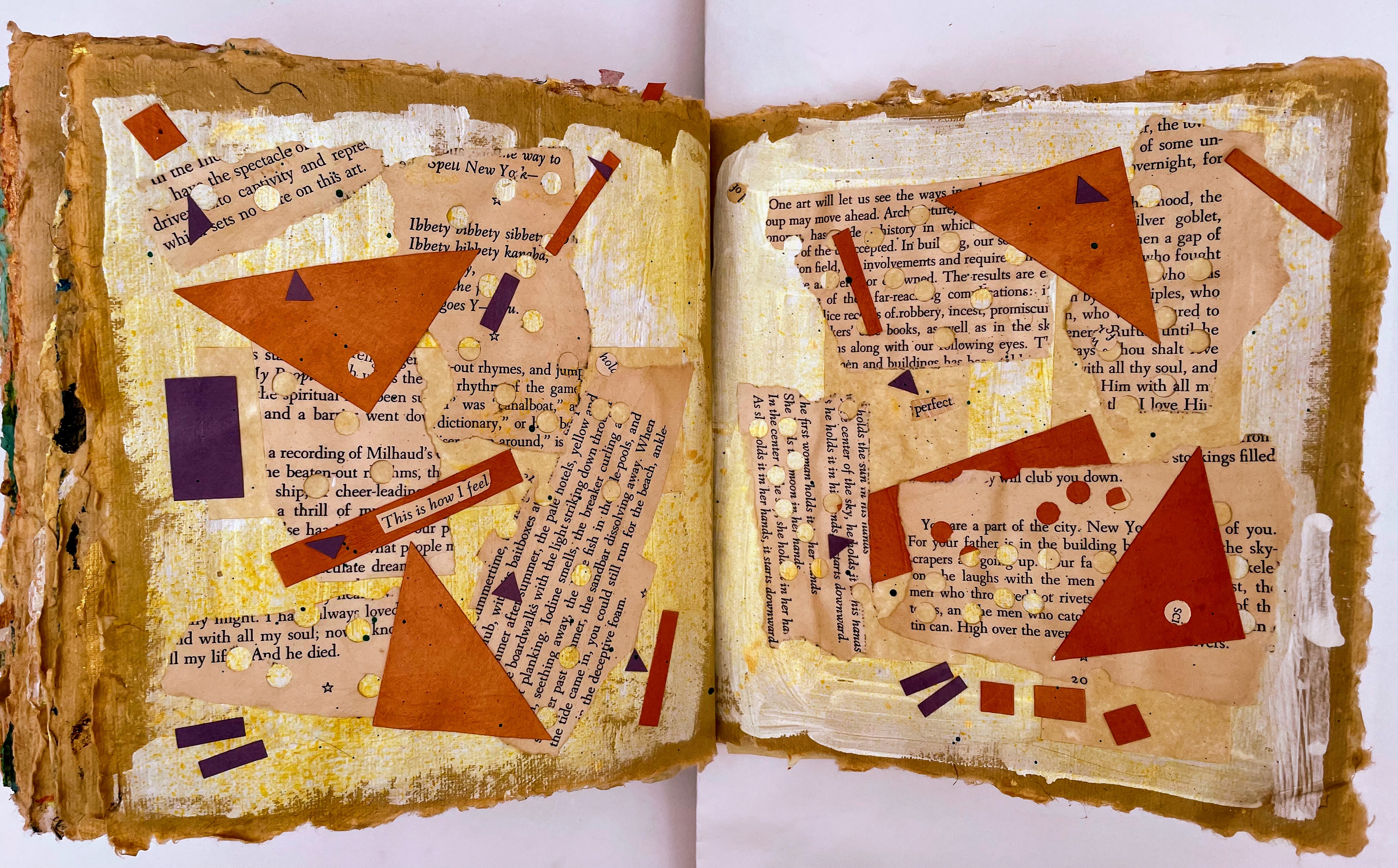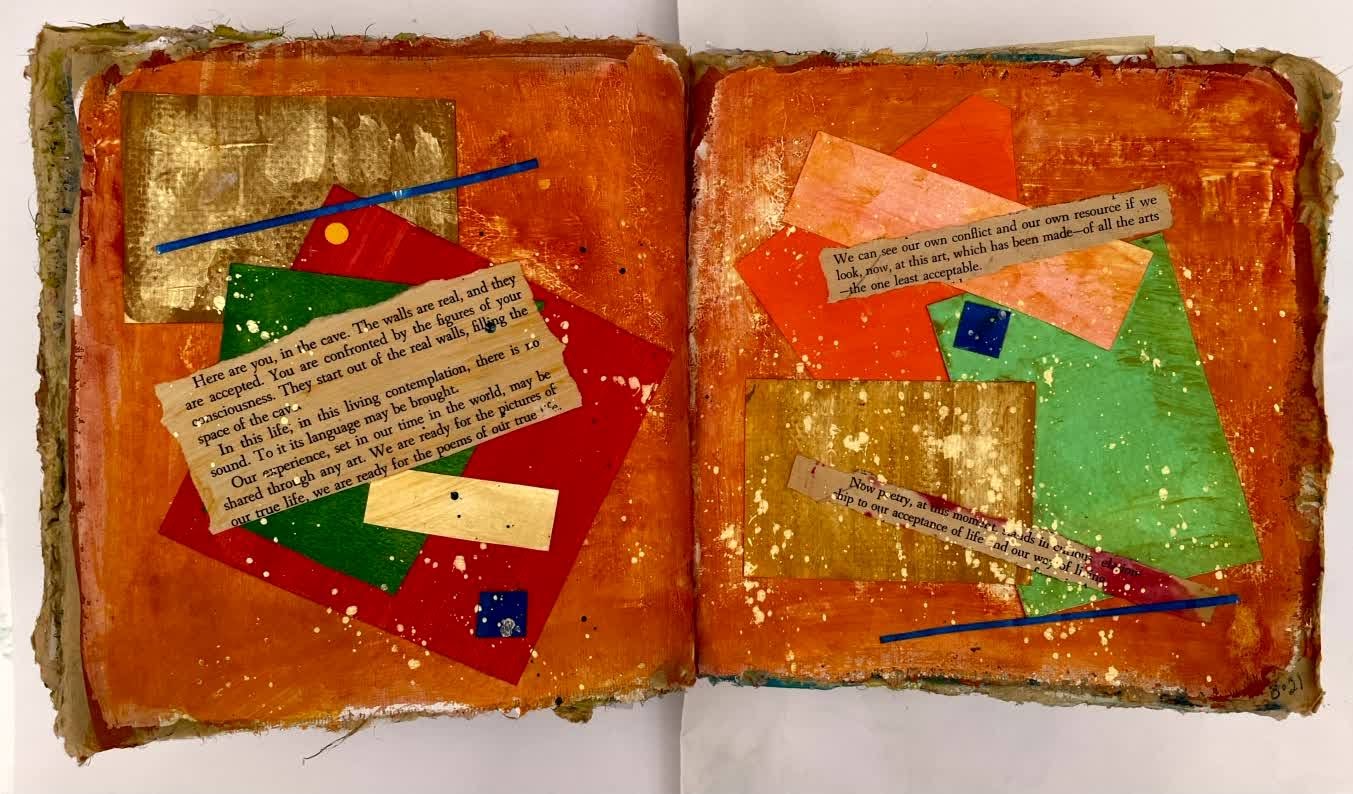
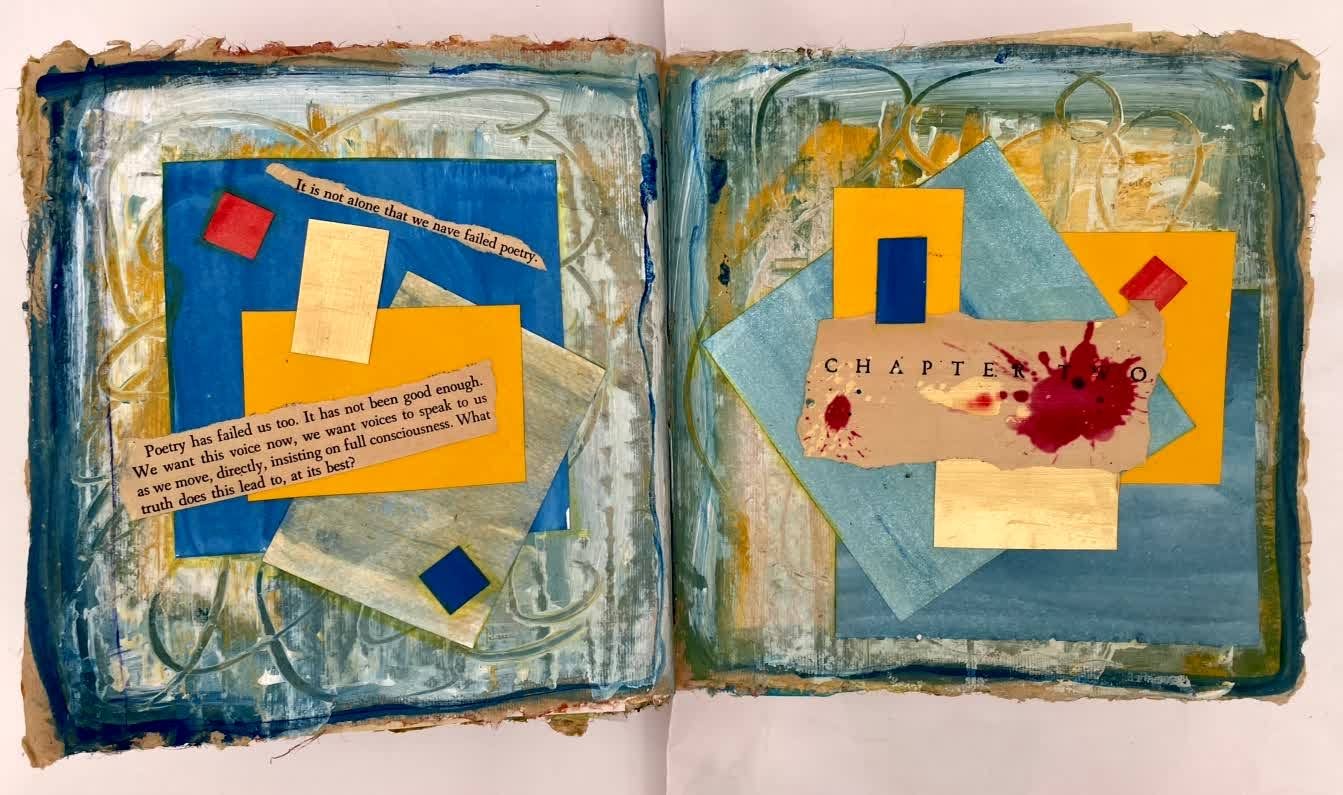
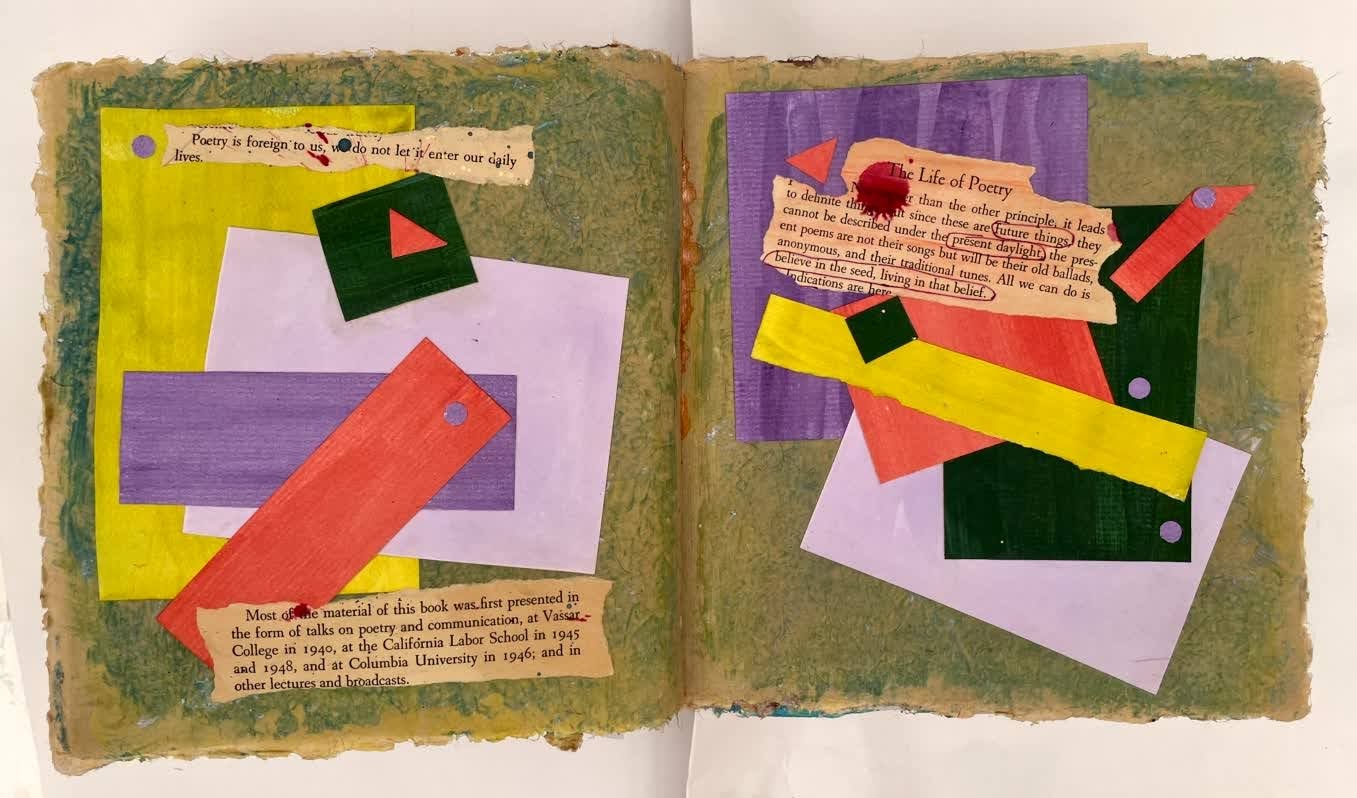

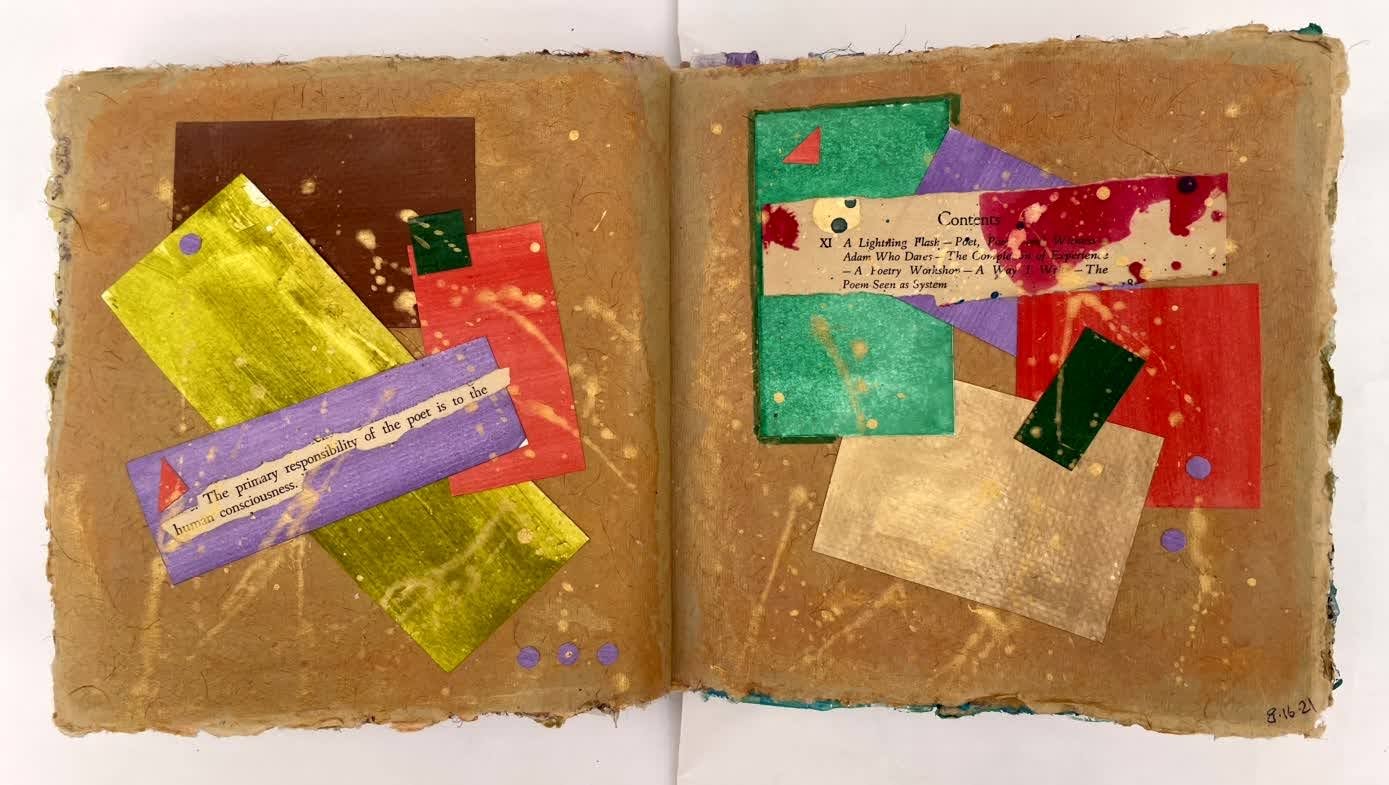

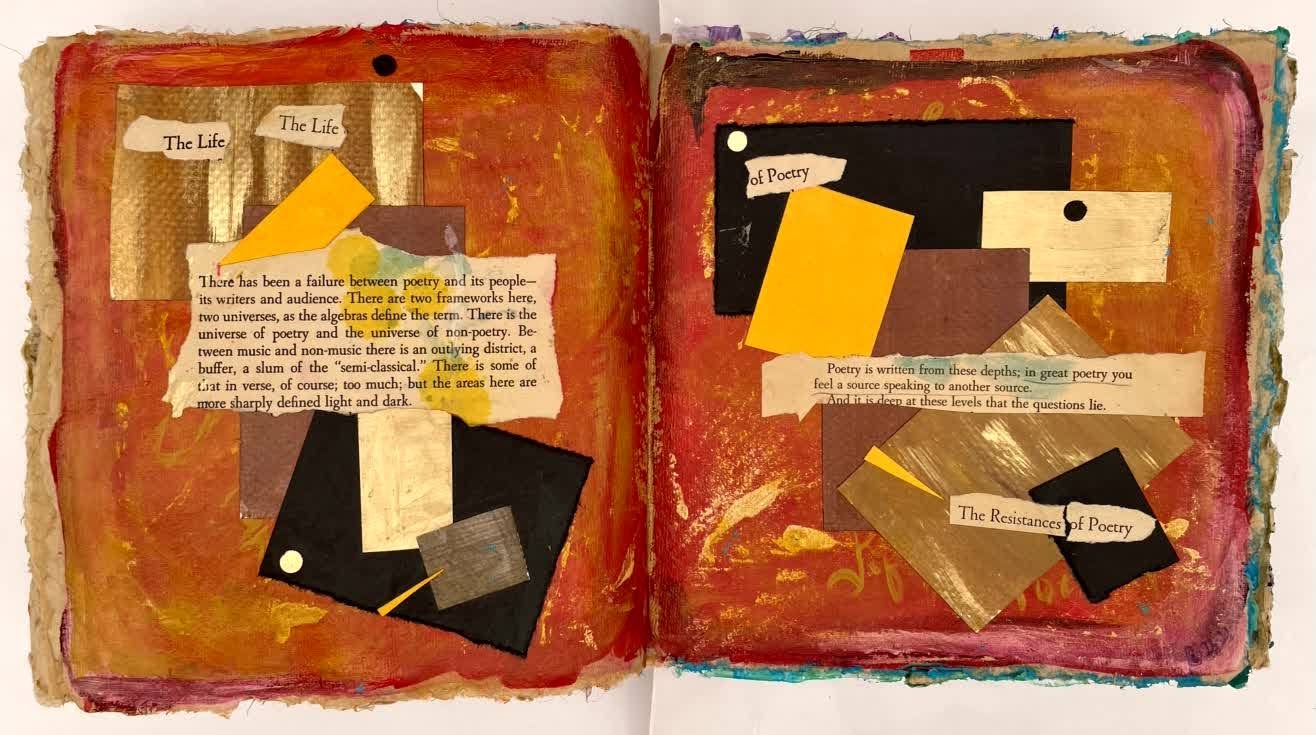
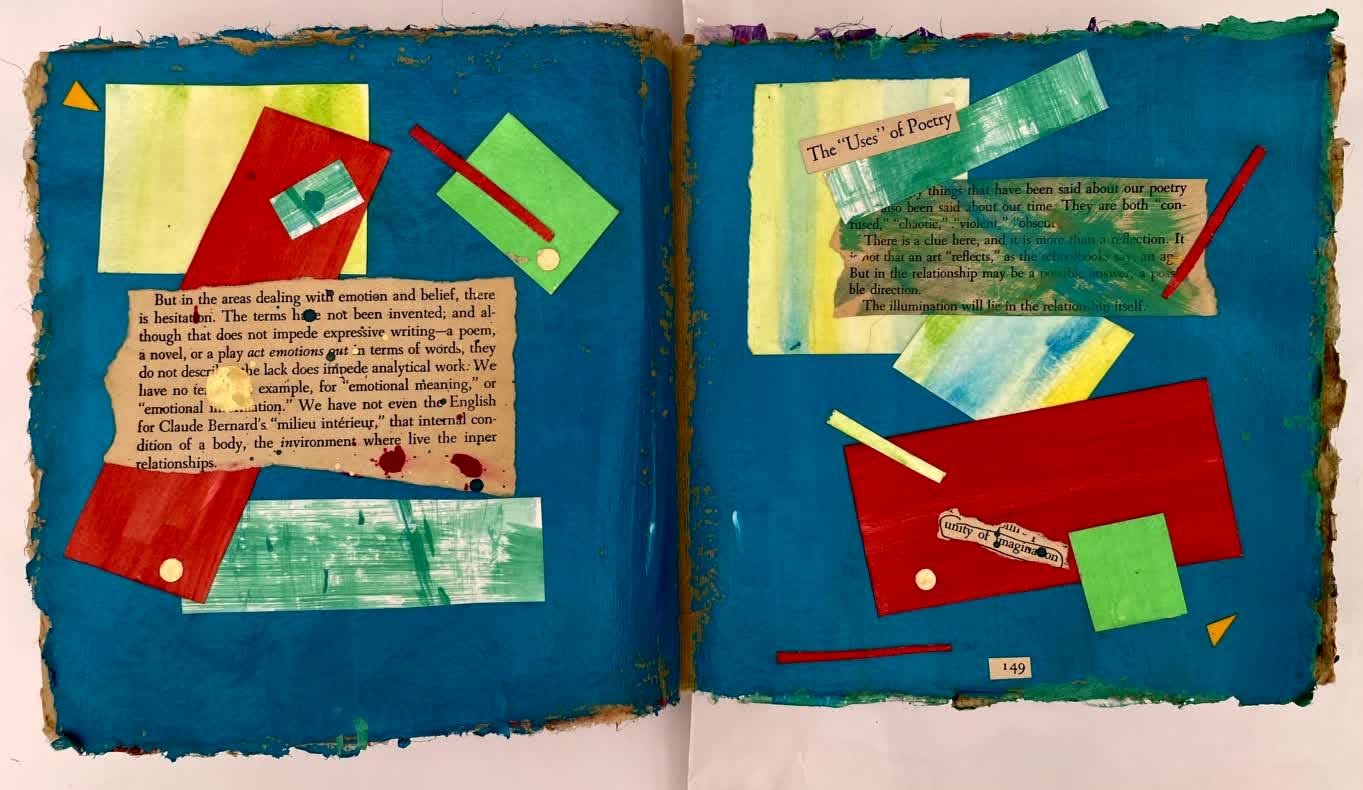


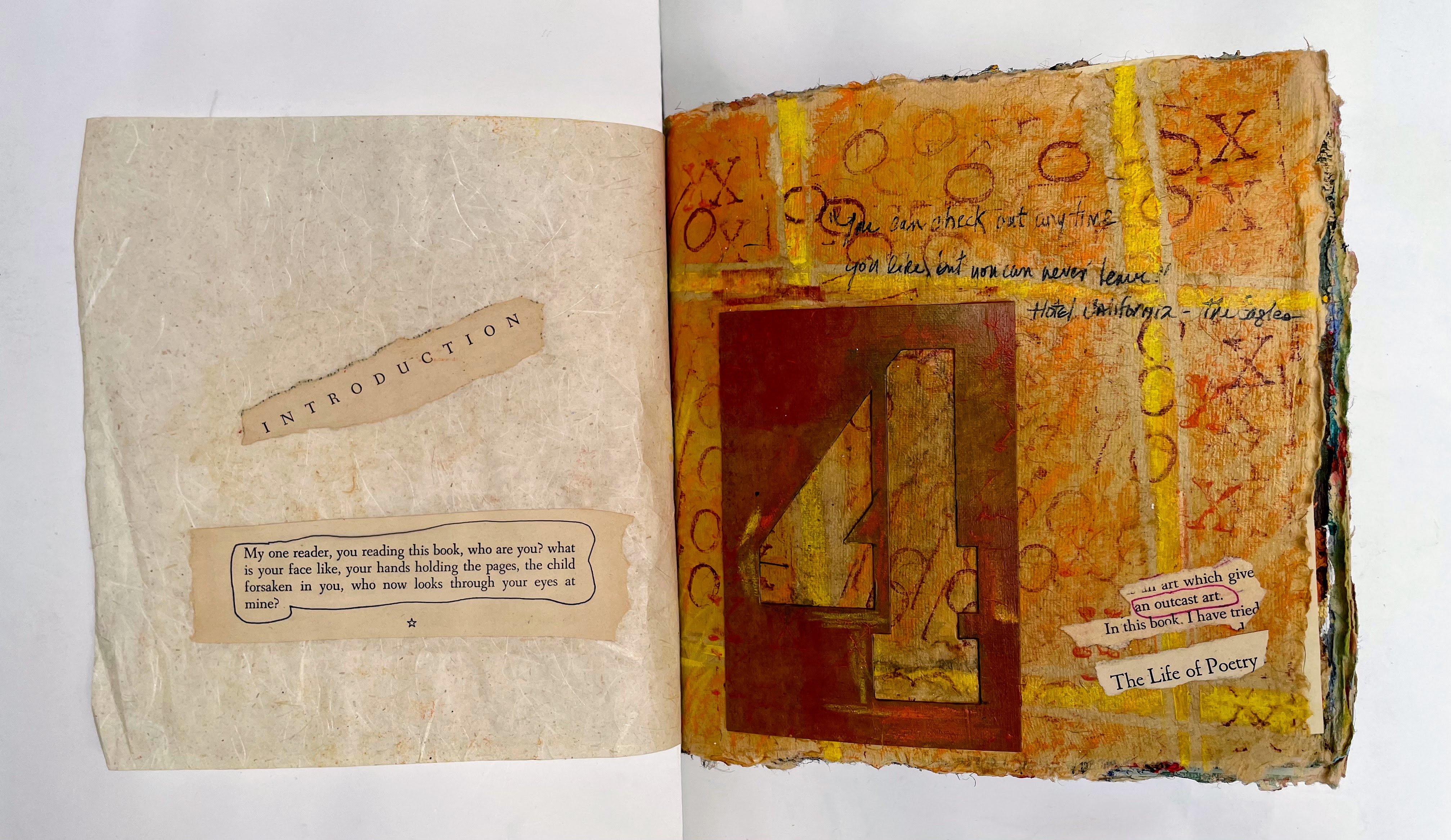
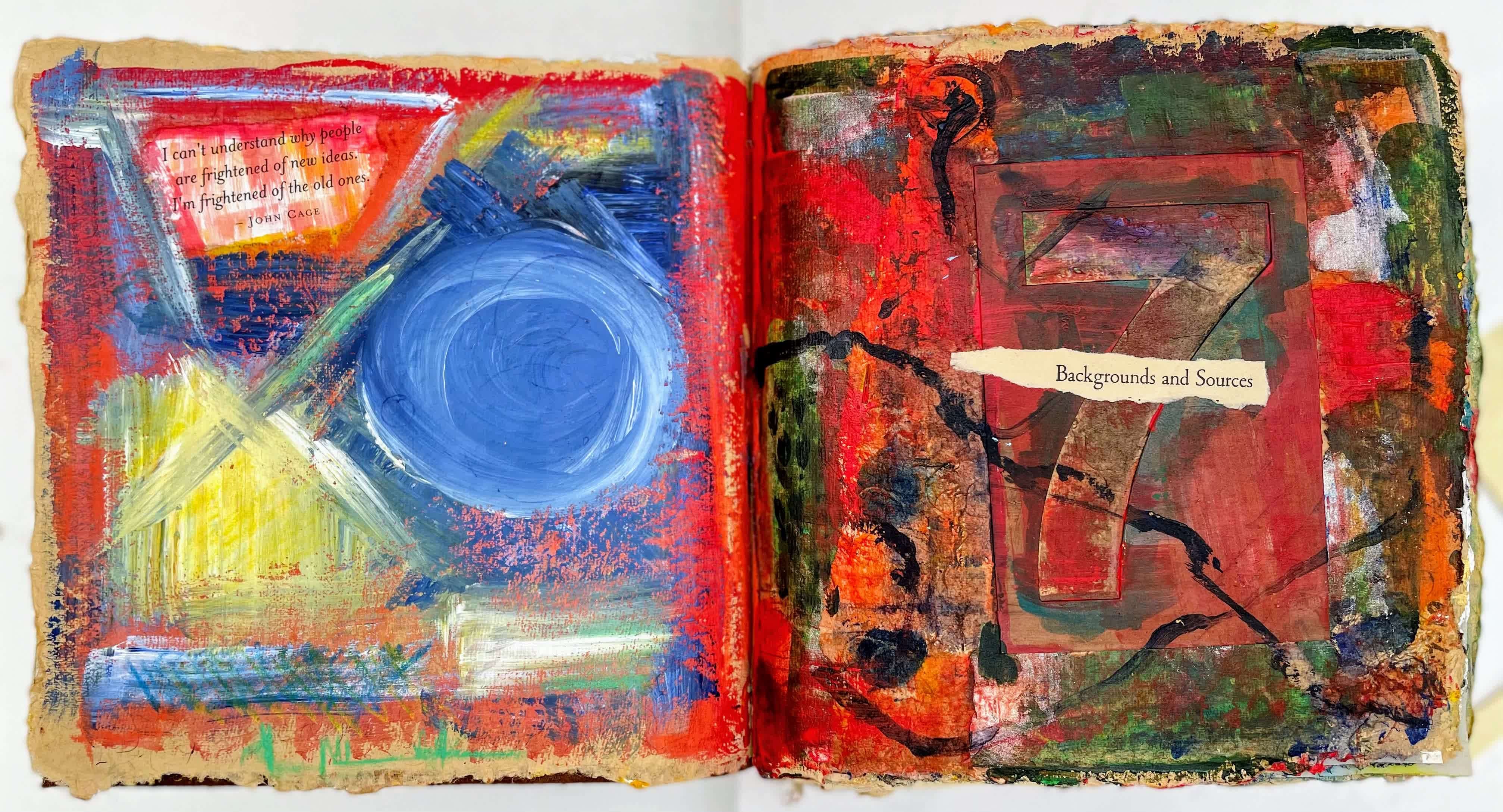
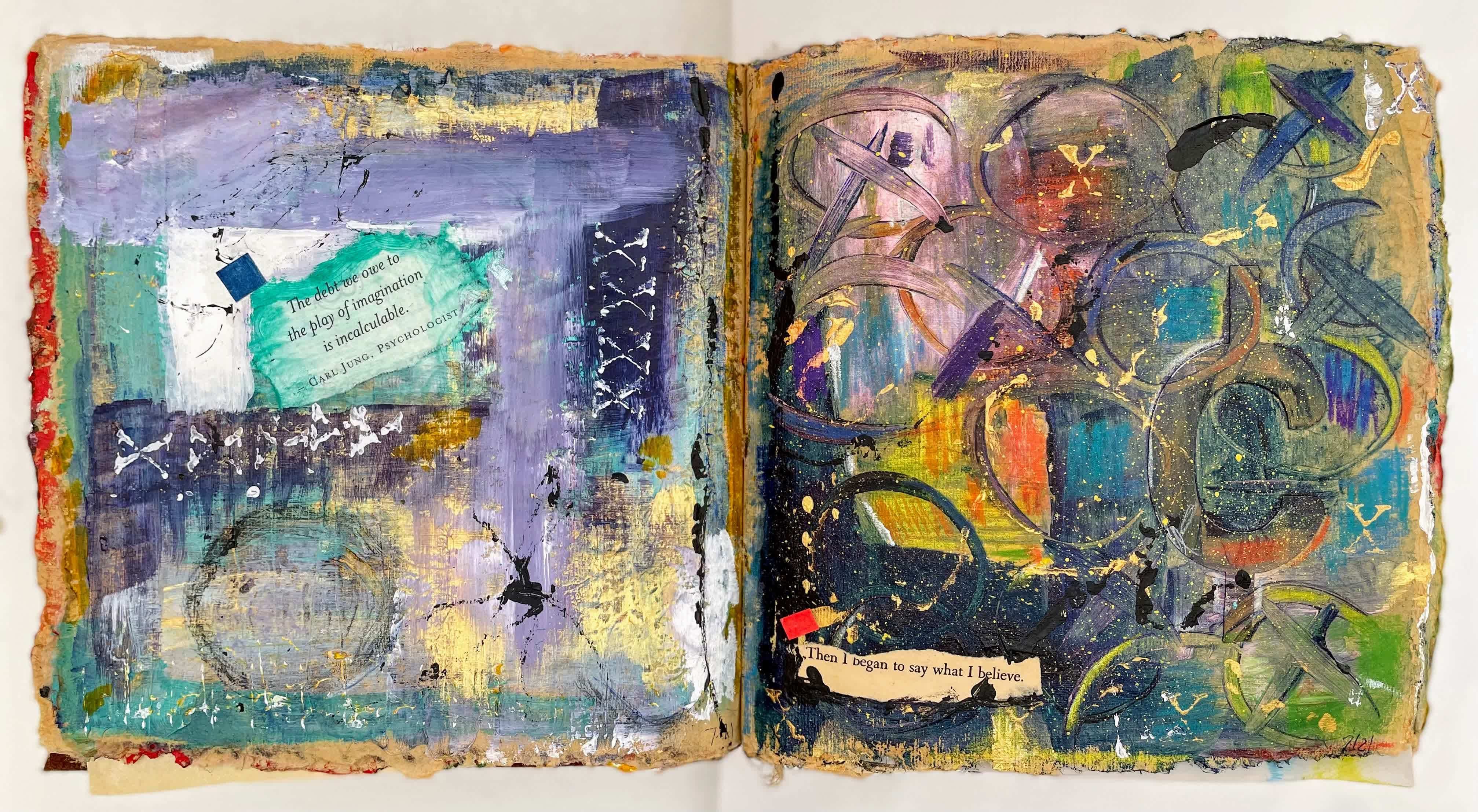
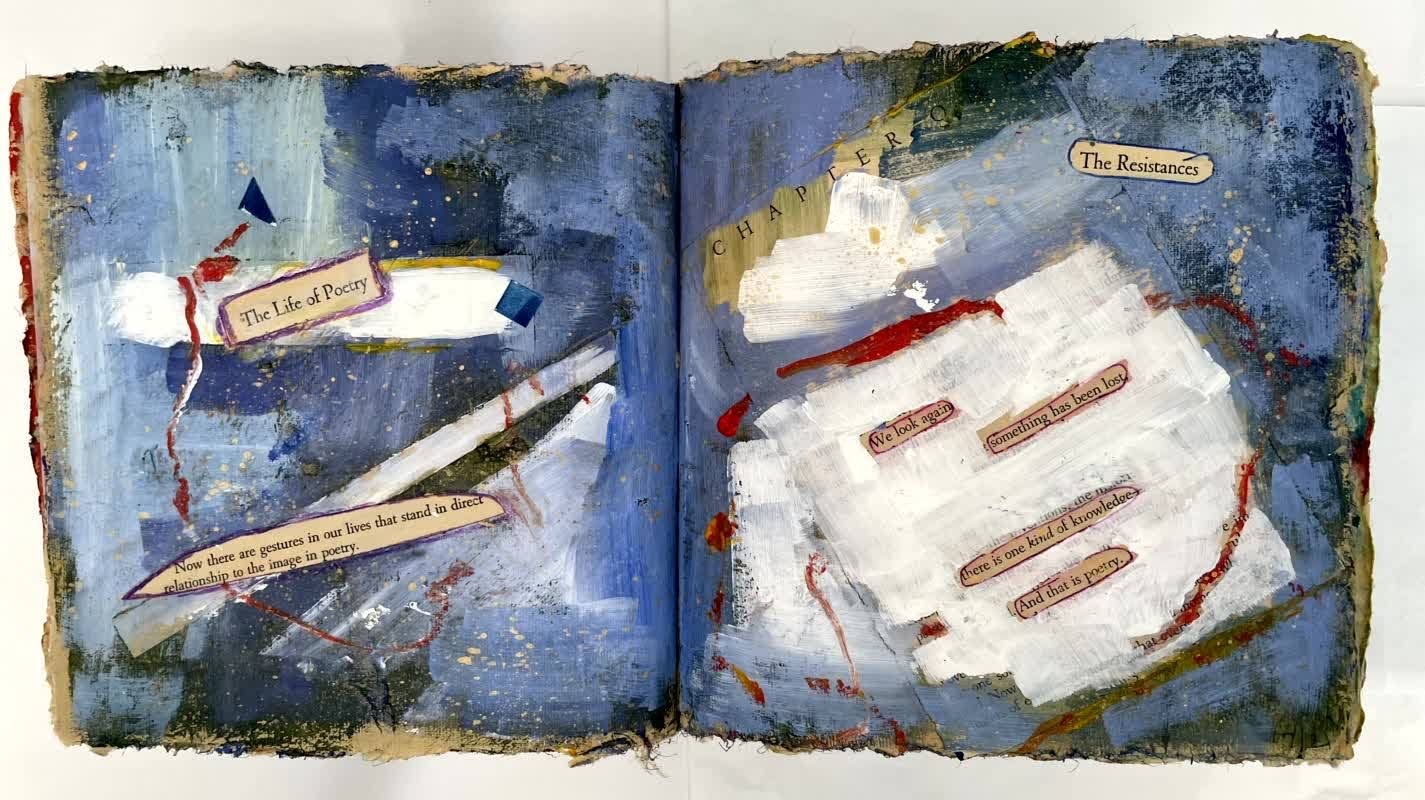
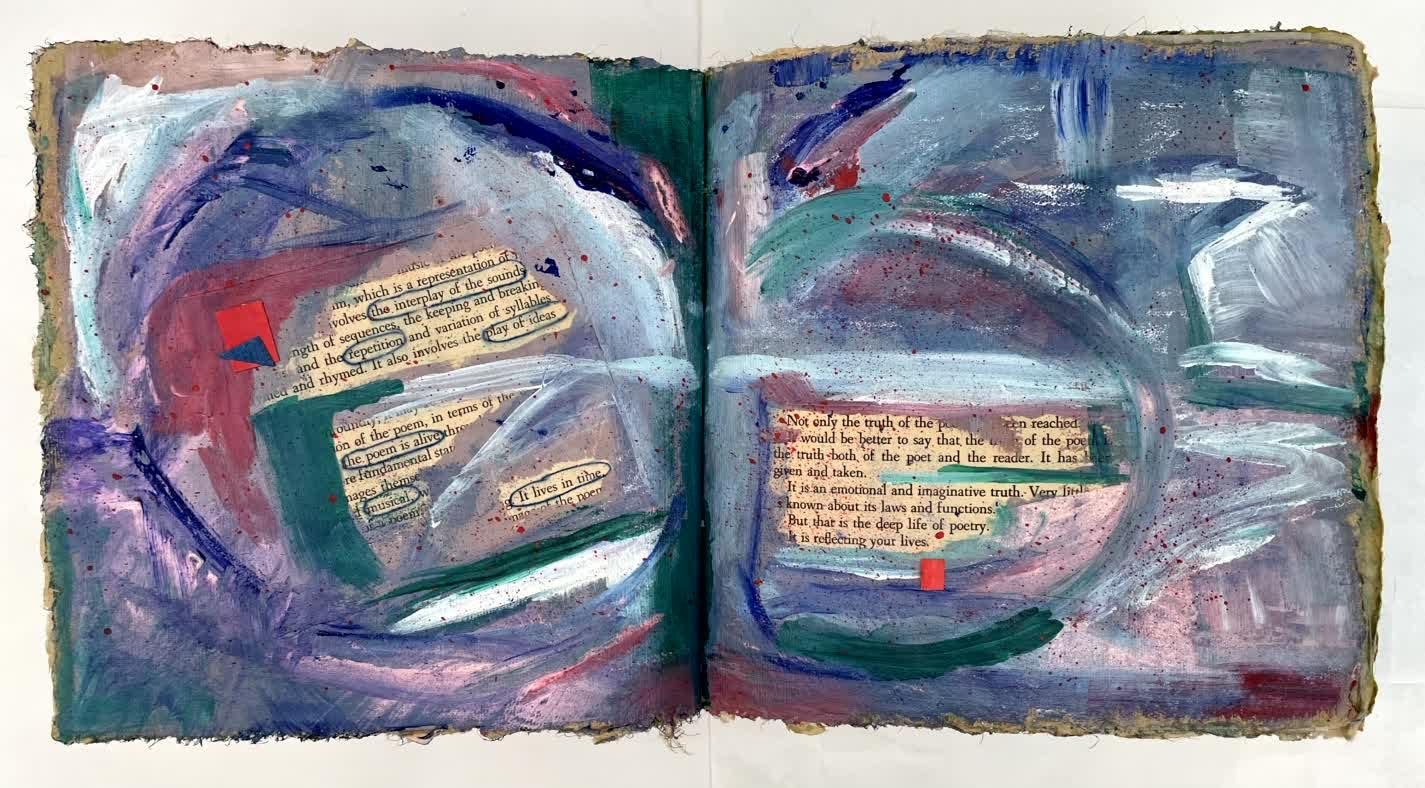
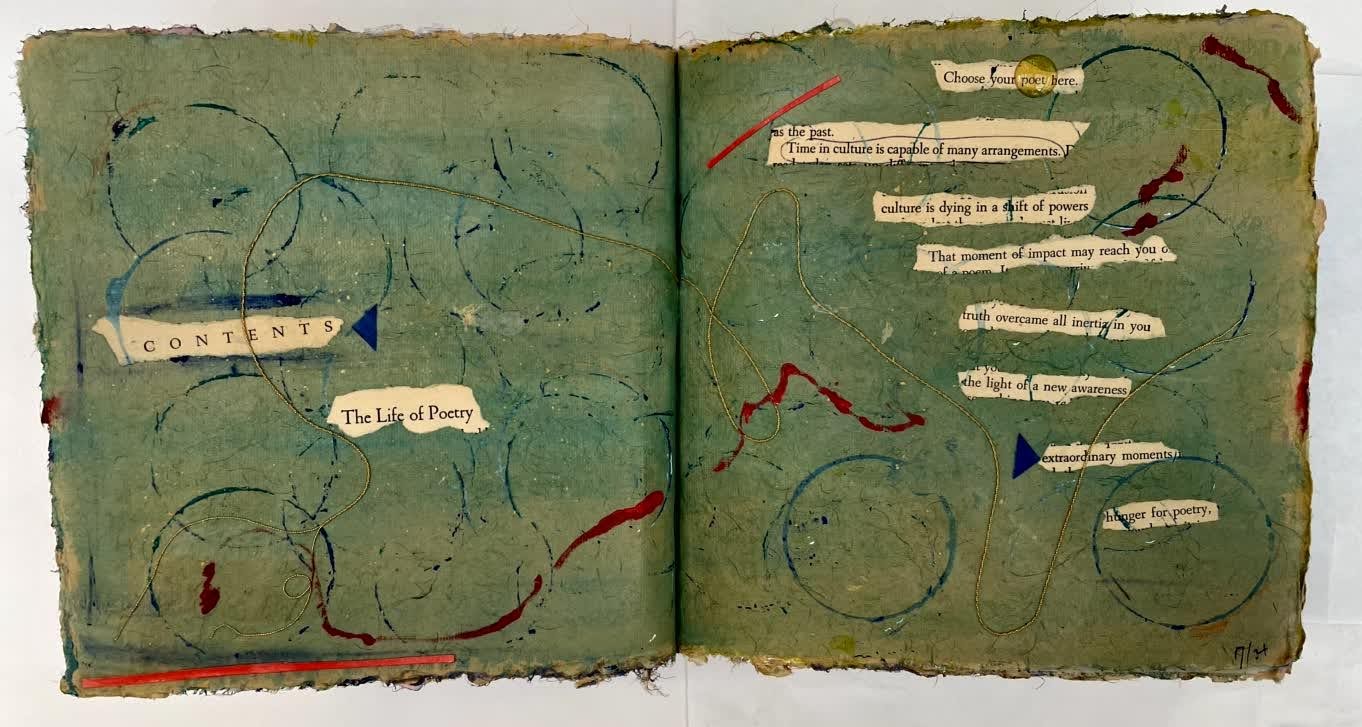
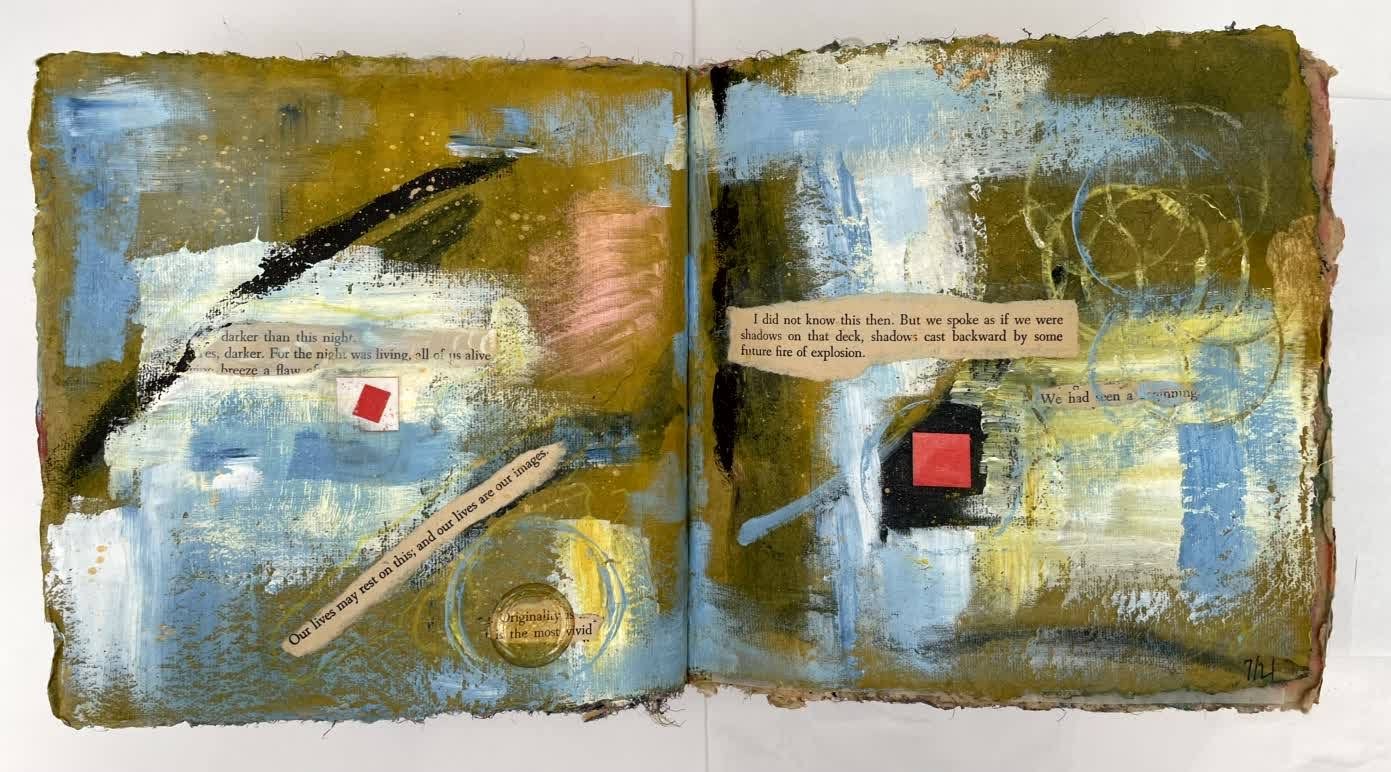
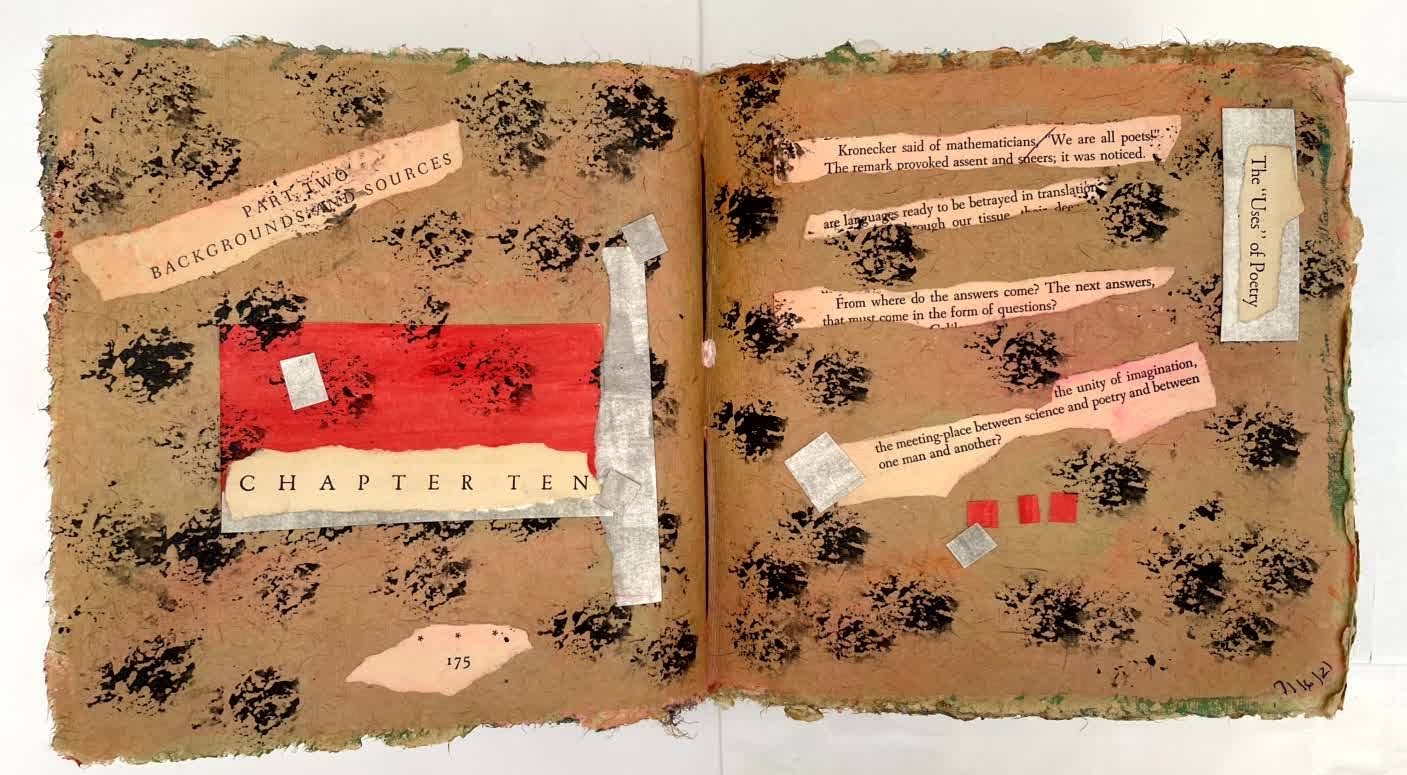
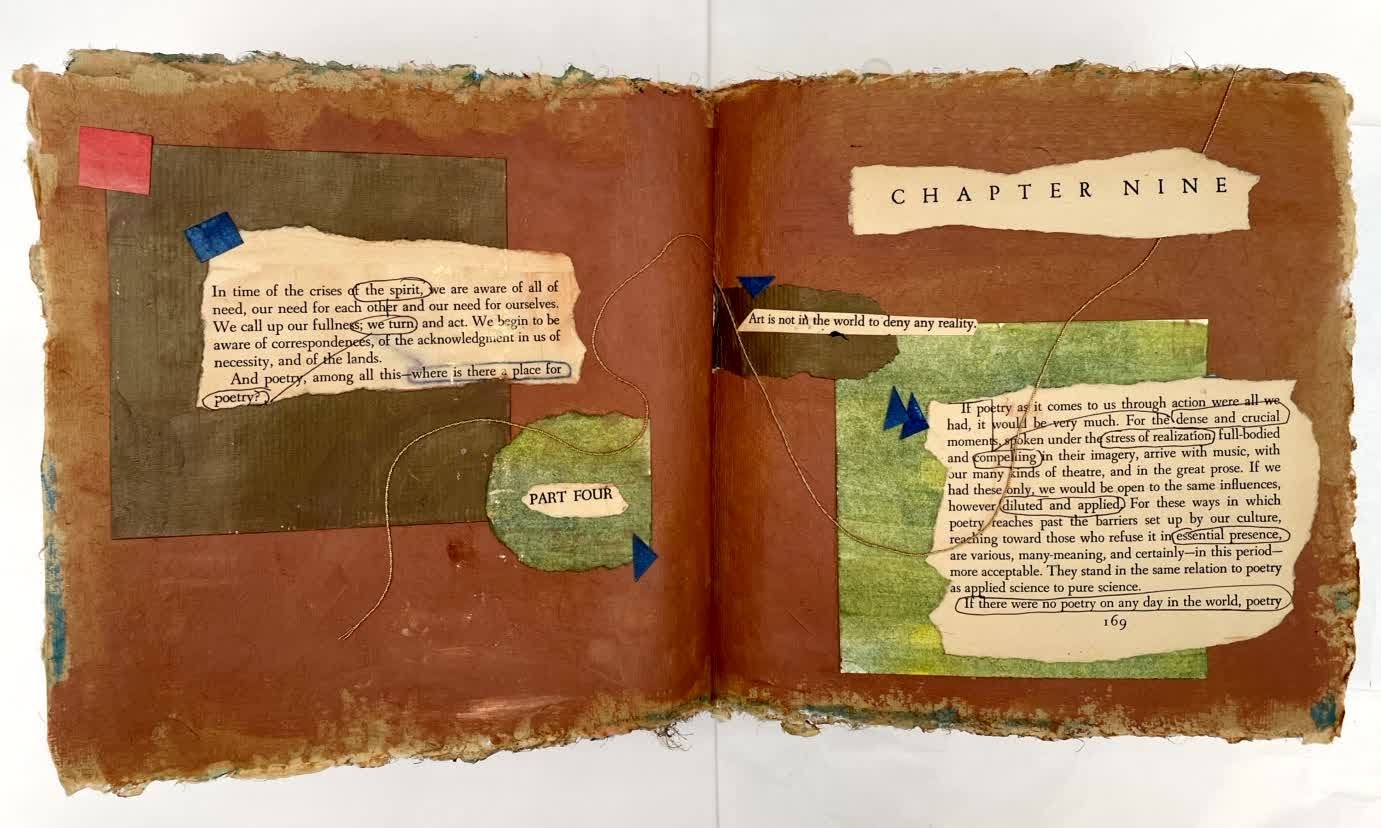

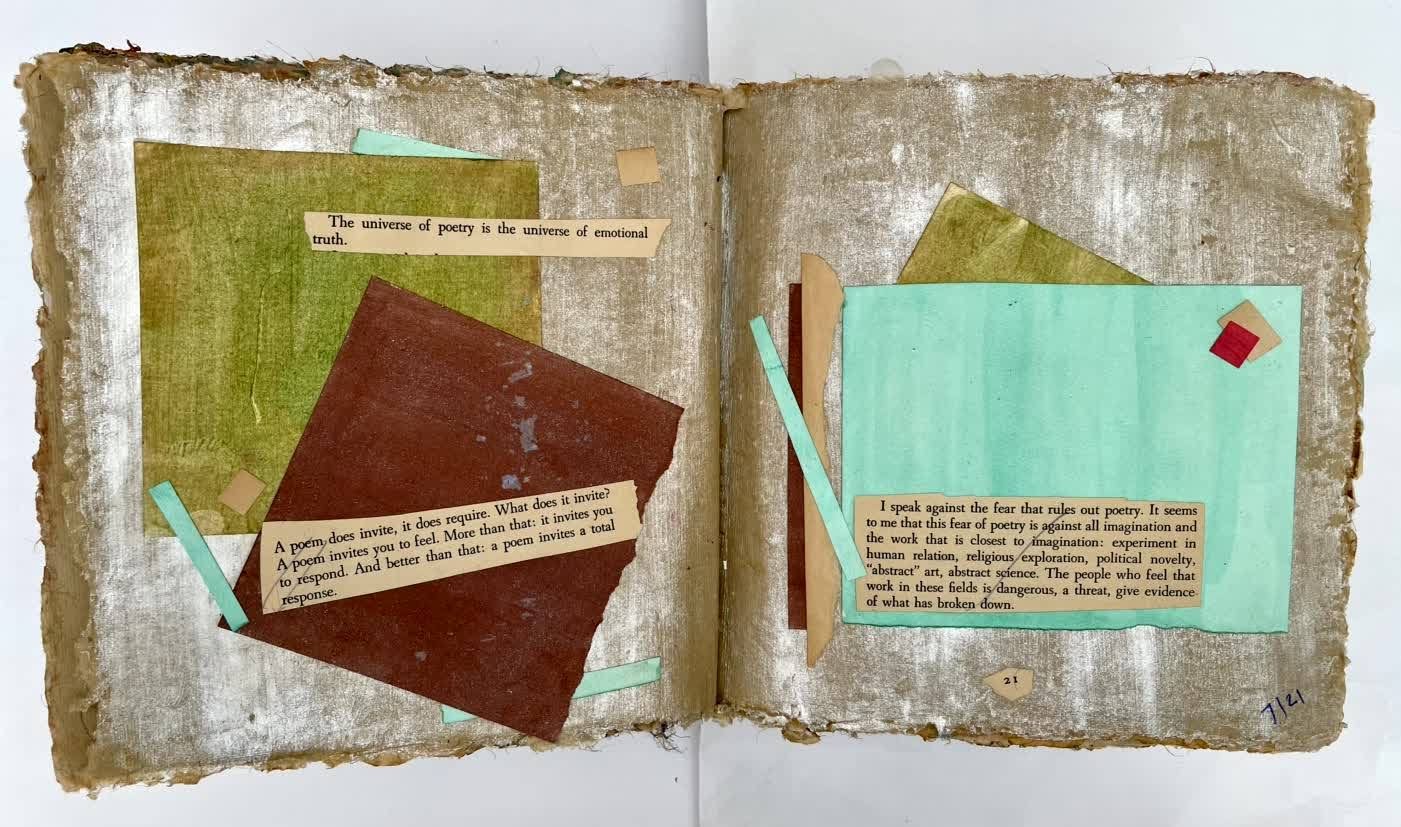
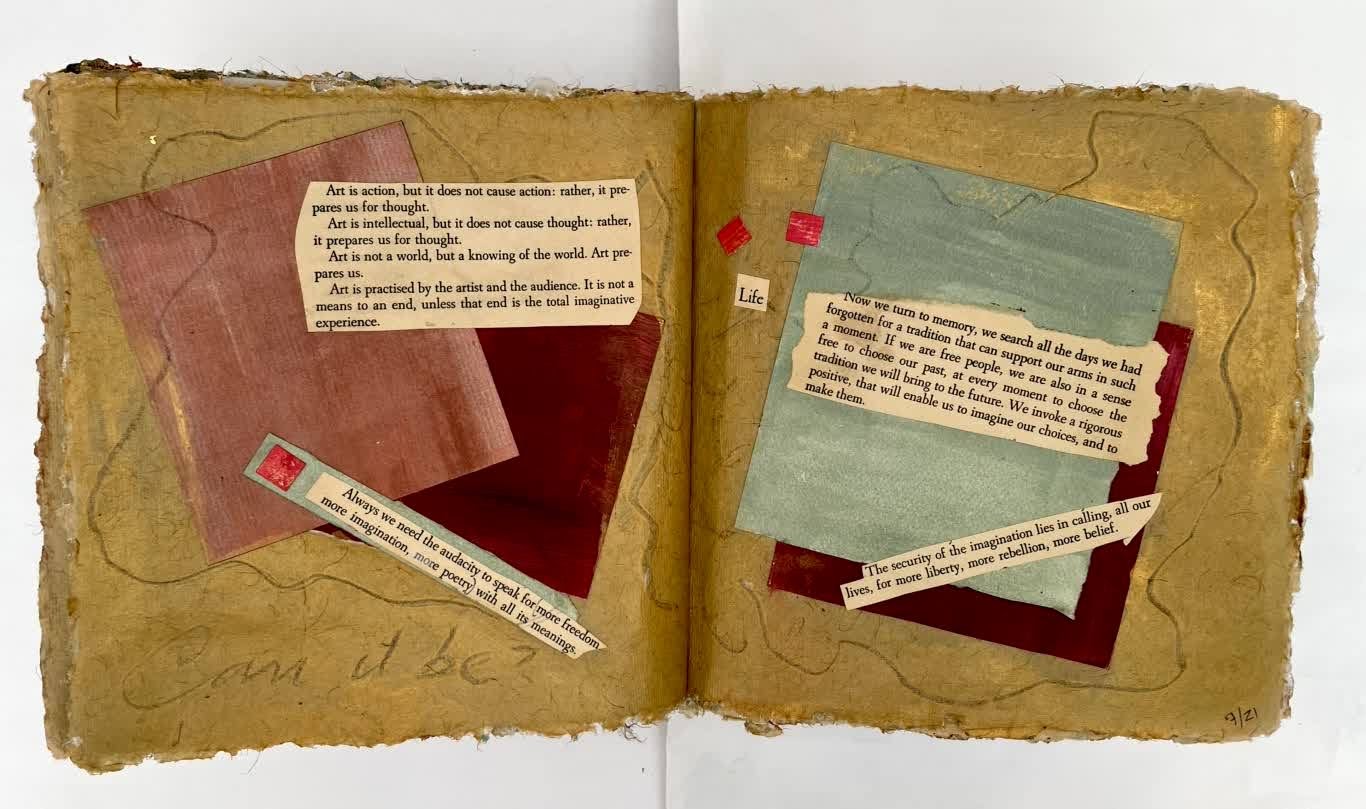

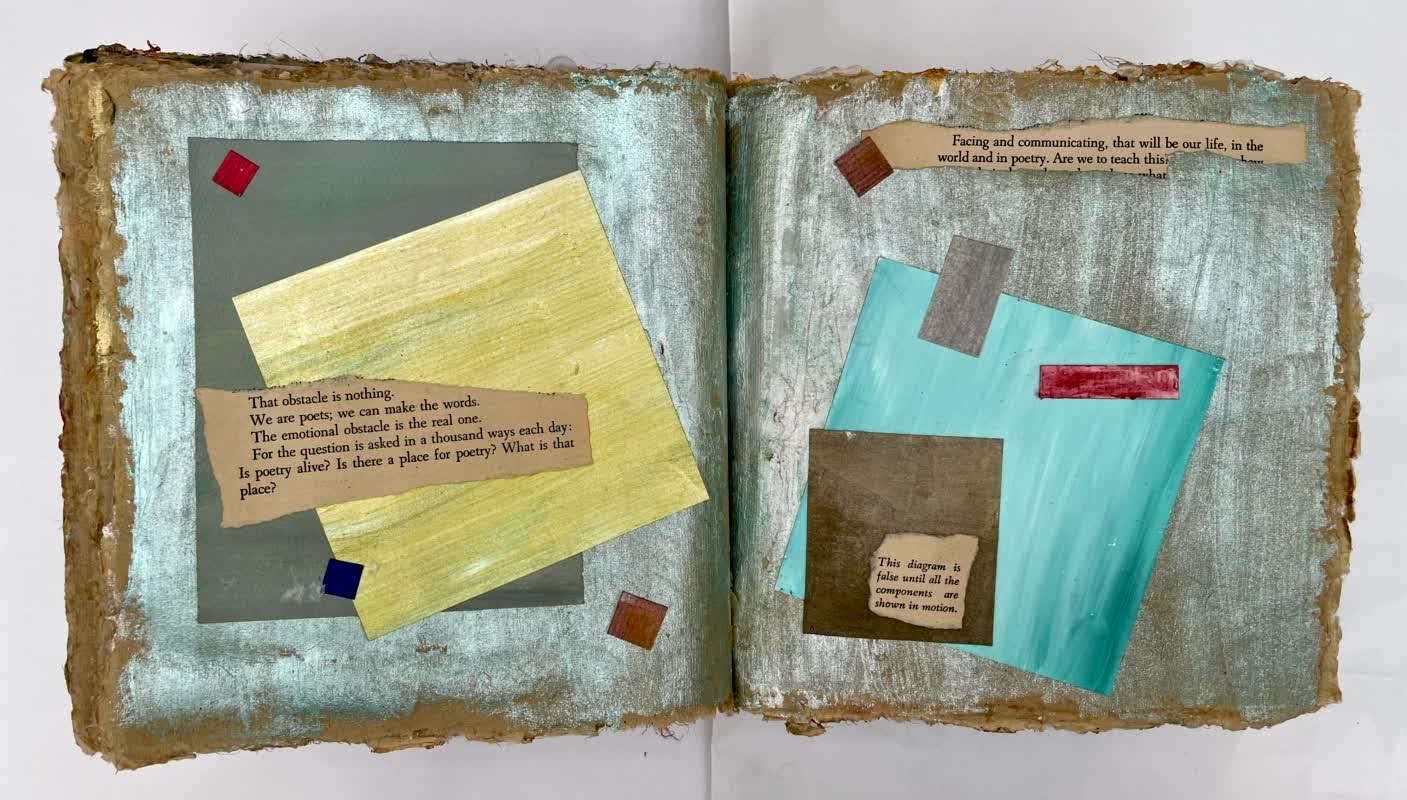
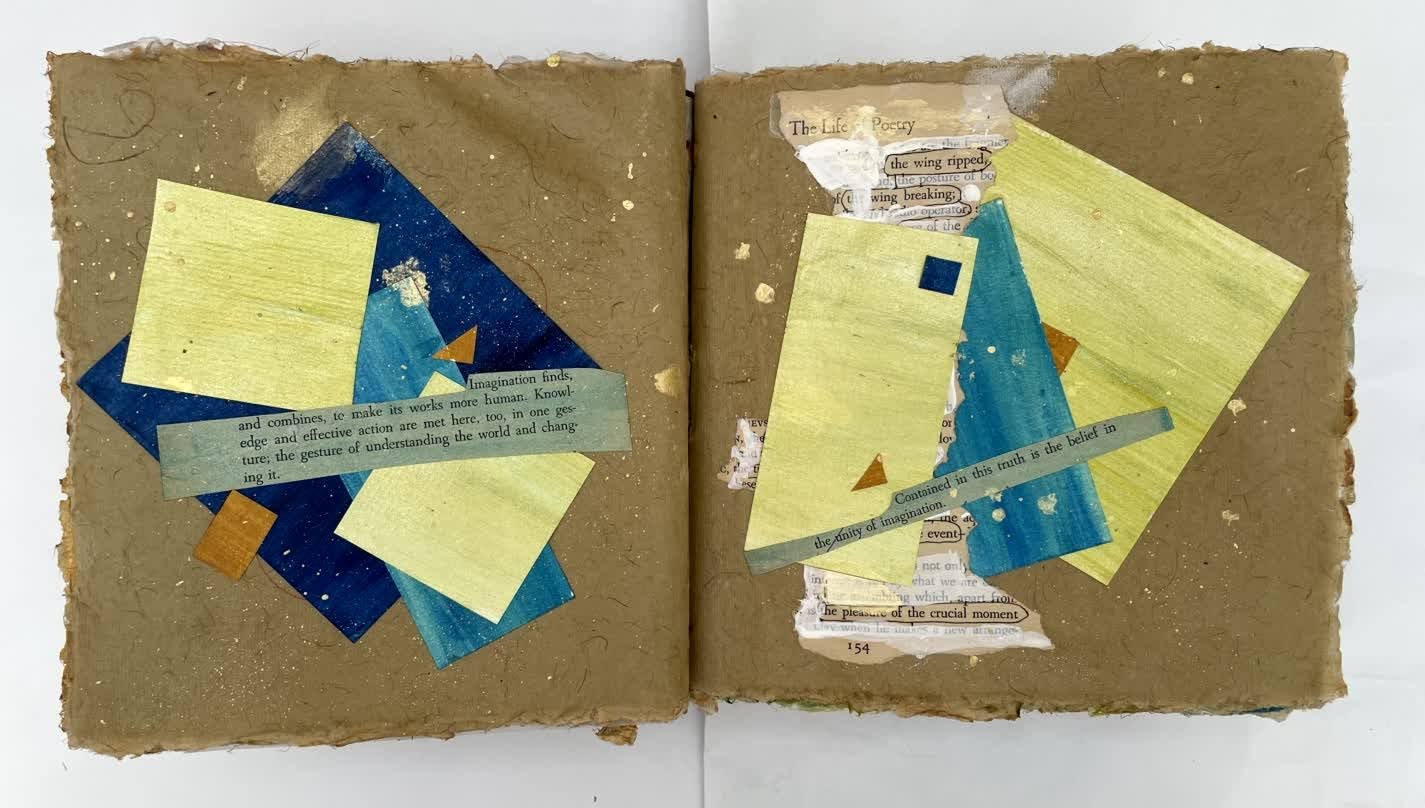

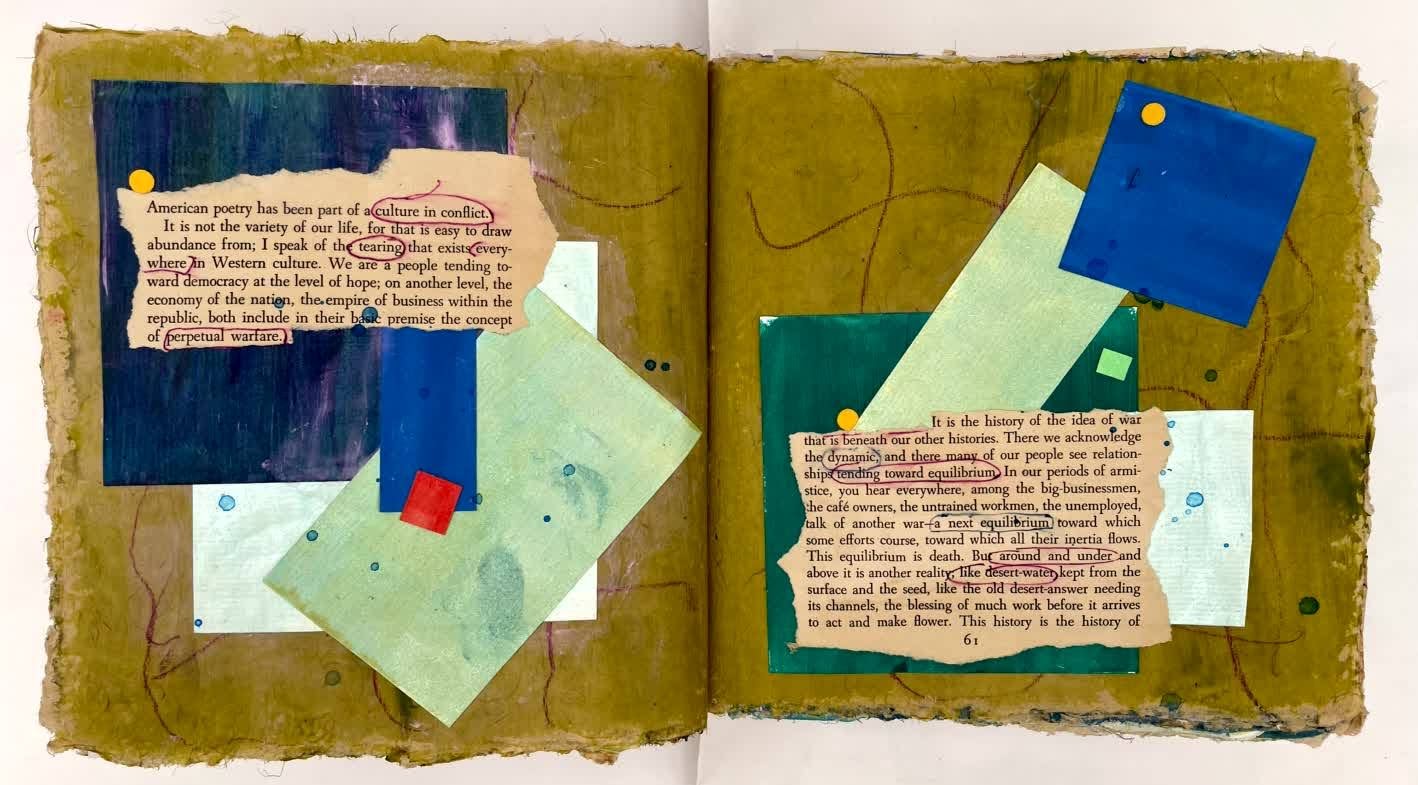
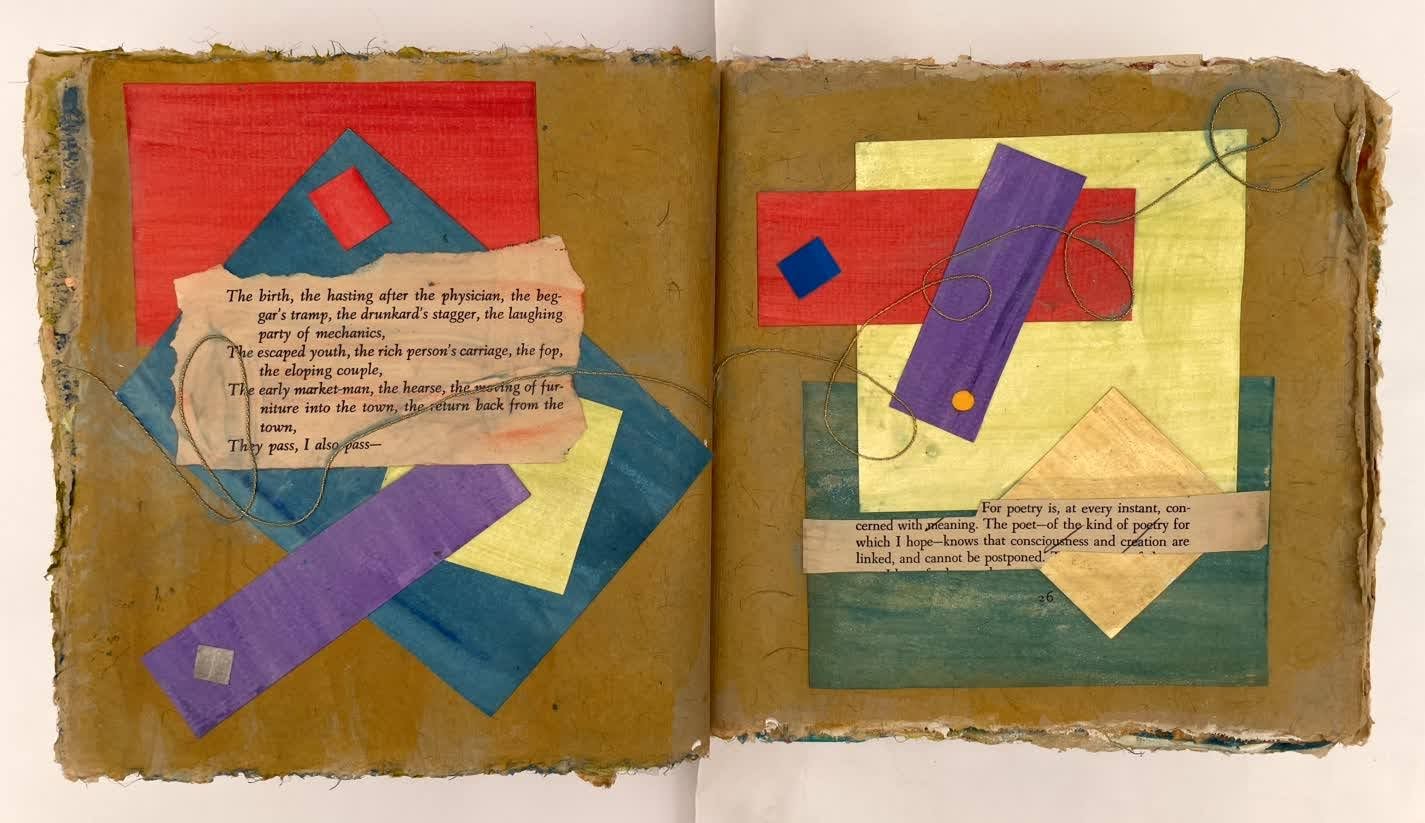
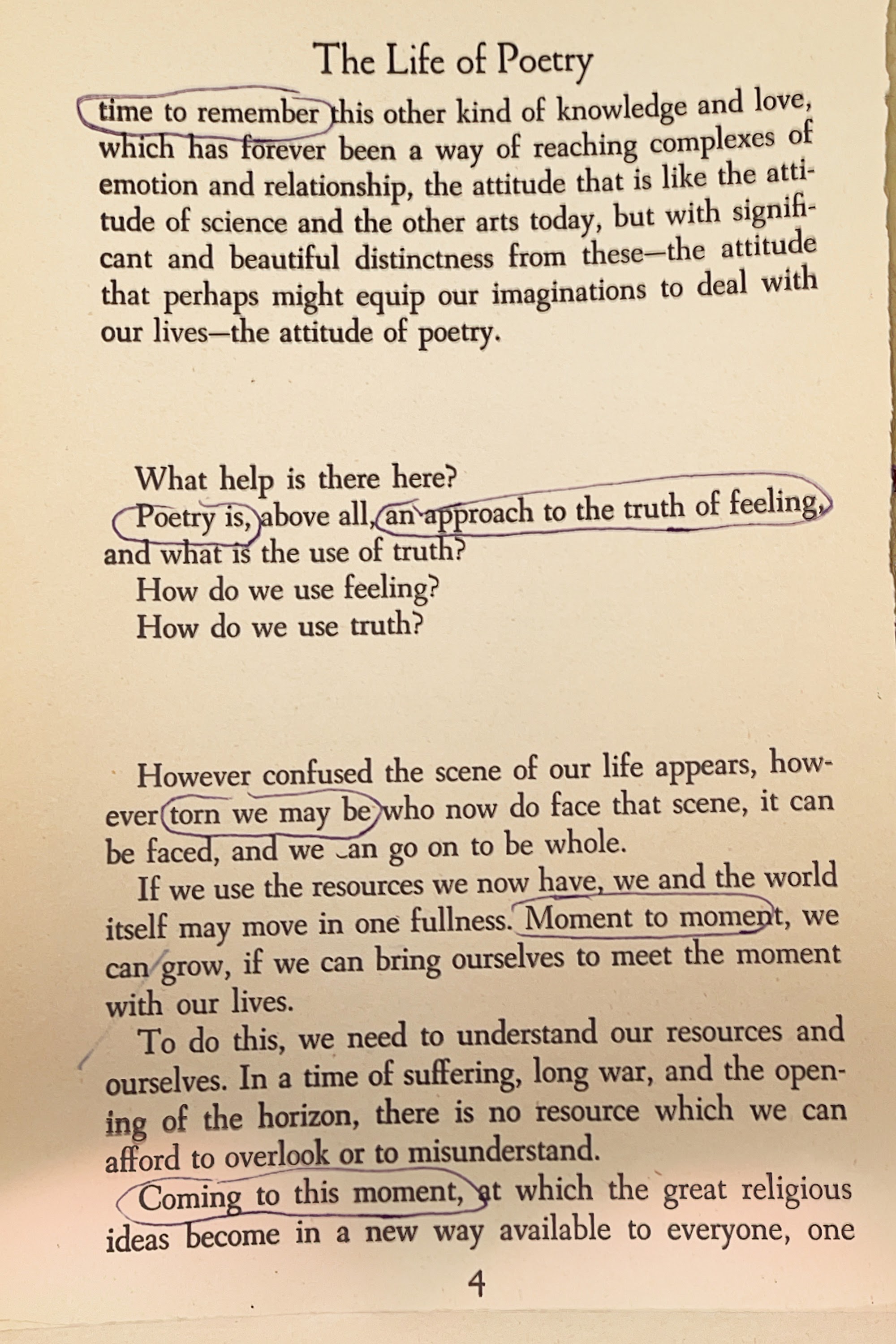
A little over a year ago, I started working in an art journal using the book The Life of Poetry written in 1949 by Muriel Rukeyser. Attracted by the title, I bought it several years ago from Dawntreader’s Bookstore in Ann Arbor for $2.50. It almost immediately fell apart. the pages were dry and crisp and falling out of the paperback binding. I was unable to read it through, but I couldn’t bring myself to toss it. The book, I discovered, was a series of lectures she gave during the 1940s. I worked my way through some chapters, thinking I might use quotes as prompts for poetry. Many of the popular cultural references were not familiar to me, but enough of the book resonated that I circled passages. Later, many of these ended up on the pages of the art journal I began in July 2021. Before my accidental book purchase, I had never heard of Muriel Rukeyser, so I was excited to learn that she was a progressive, a feminist, a poet, writer, and lecturer.
My journal is leatherbound, hand-made paper from Teresa Merriman, an artist I met at the Ann Arbor Art Fair in 2019. The journal was so beautiful that I was intimidated to even begin to fill it up. And with what? I’ve been interested in art journaling since the early 90s, when I became acquainted with the Journals of Dan Elden, a young photojournalist who was killed in Mogadishu in 1993 by US Marines who thought they were bombing warlords during the famine in Somalia. I studied Dan’s journals, talked to his mother and sister about his work, and included references to it in my master’s thesis entitled “Dialogues with the Imagination.” I circled back to these ideas in the summer of 2021 when I had some time off to focus on how to fill pages.
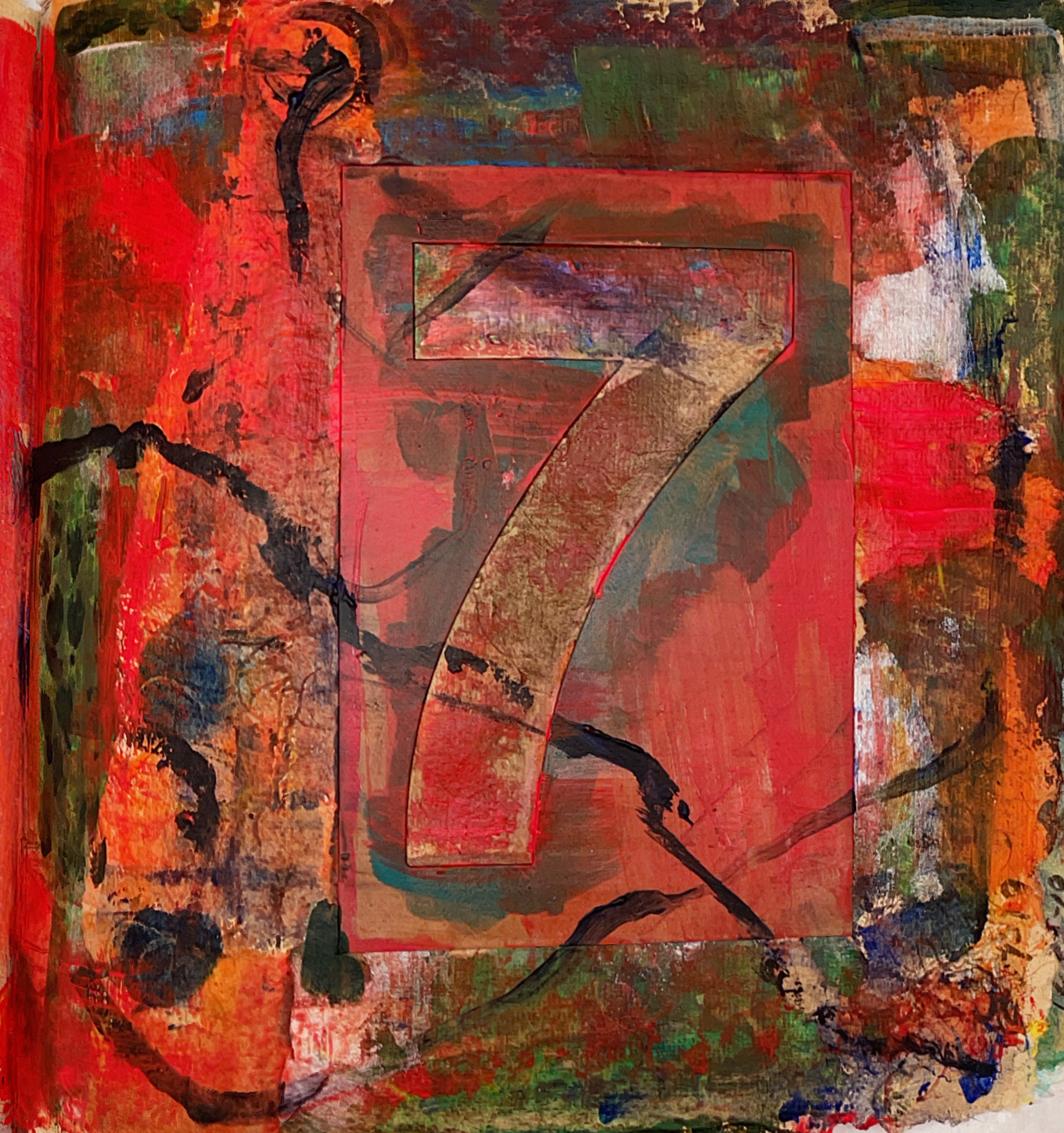
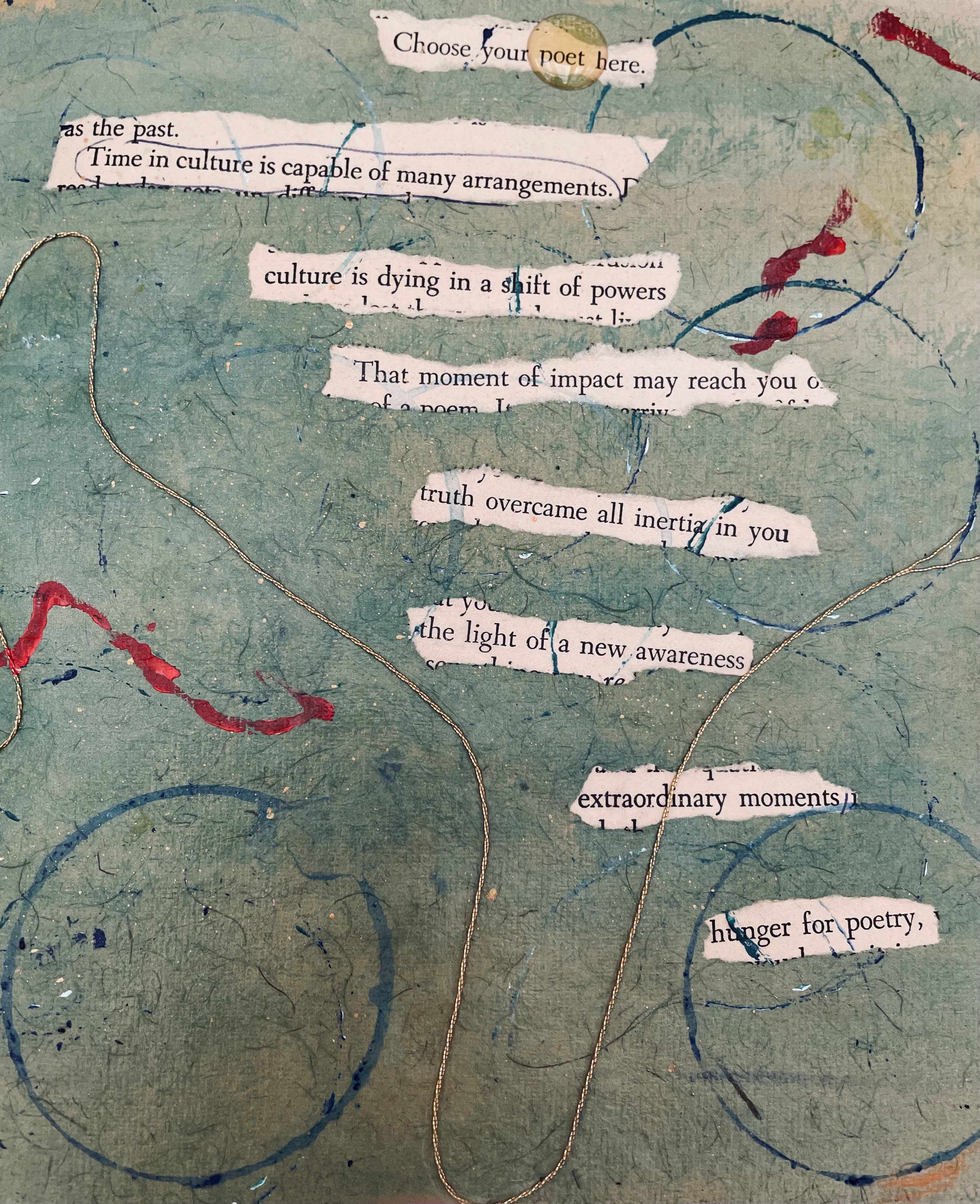
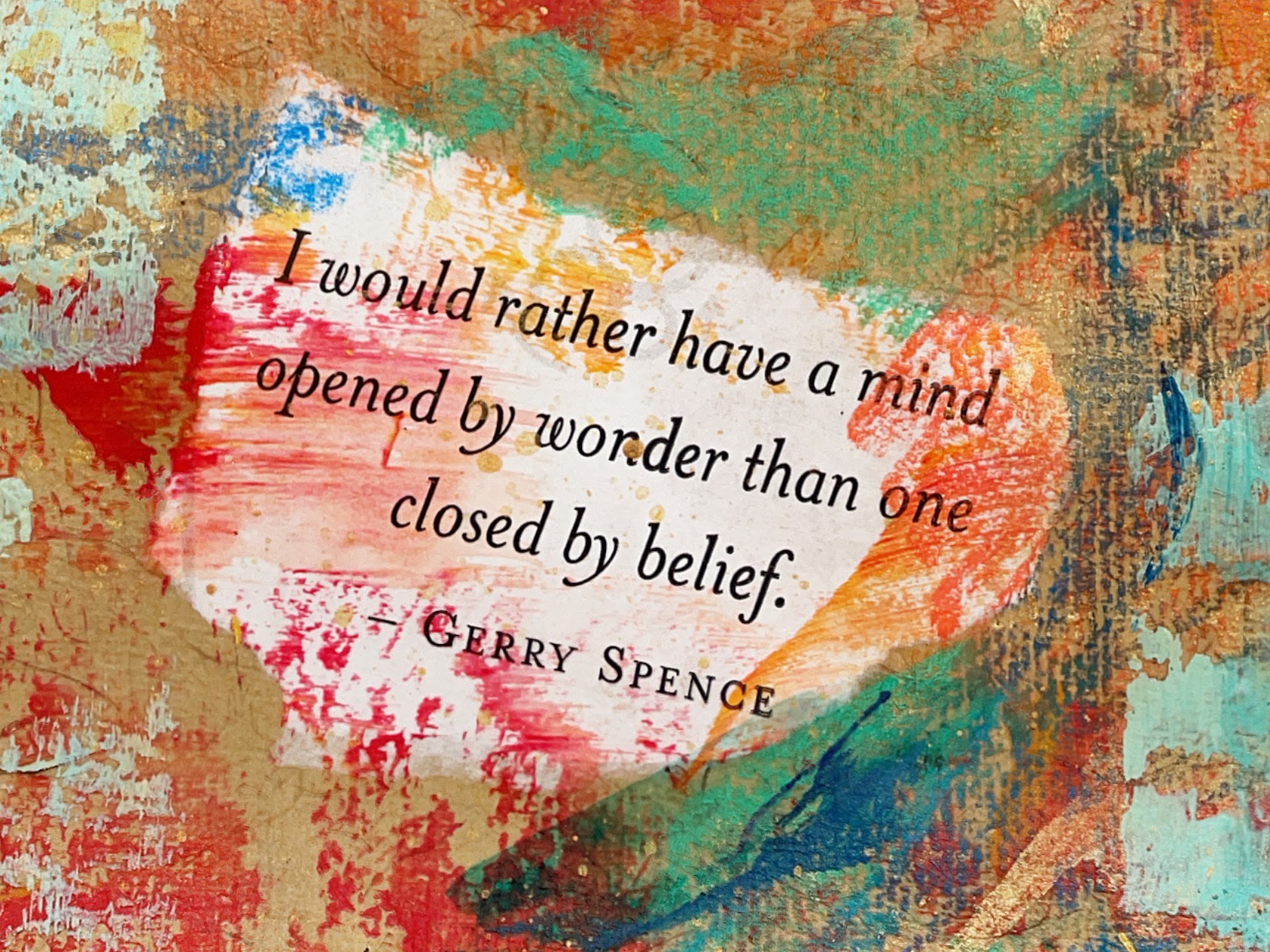
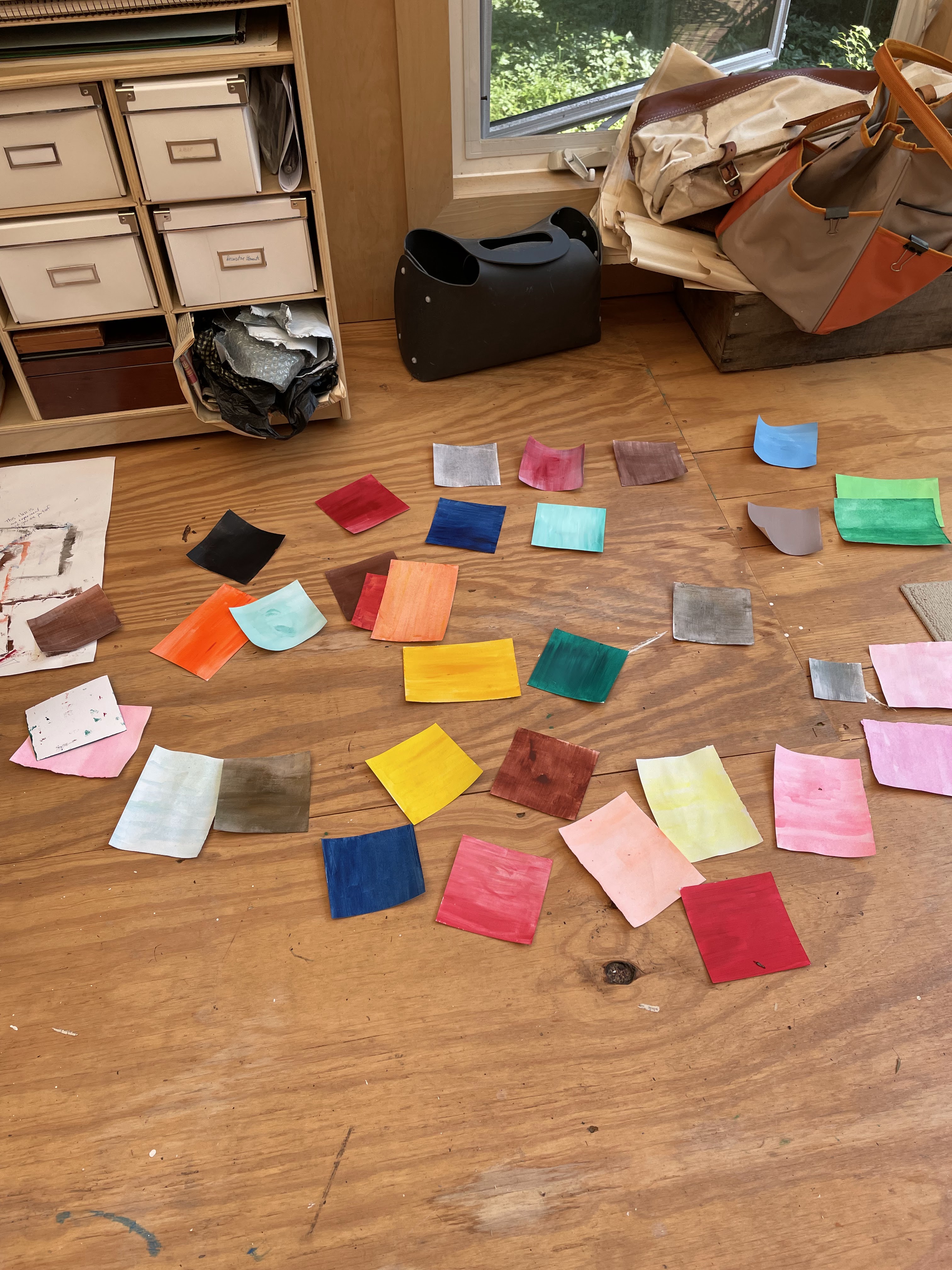
That summer, I discovered I could work each day in a different way and embraced a process that produced consistently satisfying work over the summer and fall. I lost a bit more of the fear and perfectionism each day I worked. When I didn’t know what to do, I sifted through the pages of the Rukeyser’s book, or I sorted through scraps of colored paper. Since I hate wasting paint, I used every bit by painting squares that I could use down the road. I threw them on the floor of my studio to dry, and the floor became my palette–but a dry one I could move around. Early on, I made the decision to have fun with it. I decided that each double-page spread should be related–almost as one image. Gel medium needs time to dry, which was very helpful because I had to work in sprints; this forced me to be more patient and deliberate. Pick a palette, create a background of textures, arrange the shapes, choose the text, and embellish with metallics or spatters. I developed a vocabulary of arrows, dots, rectangles, and squares that would move the eye across the pages. I photographed my progress. There are only a few pages left, so I spent some time with Rukeyser’s poetry. I have to say I was inspired by the fact that some of it is not that good. In The Speed of Darkness, there are a few that stand out. It’s encouraging, actually. I’ve just begun reading from her collection Out of Silence and these poems are contemporary, powerful, and authentic. I plan to use some as prompts for my own. Below are a few images from my journal when it was in progress.





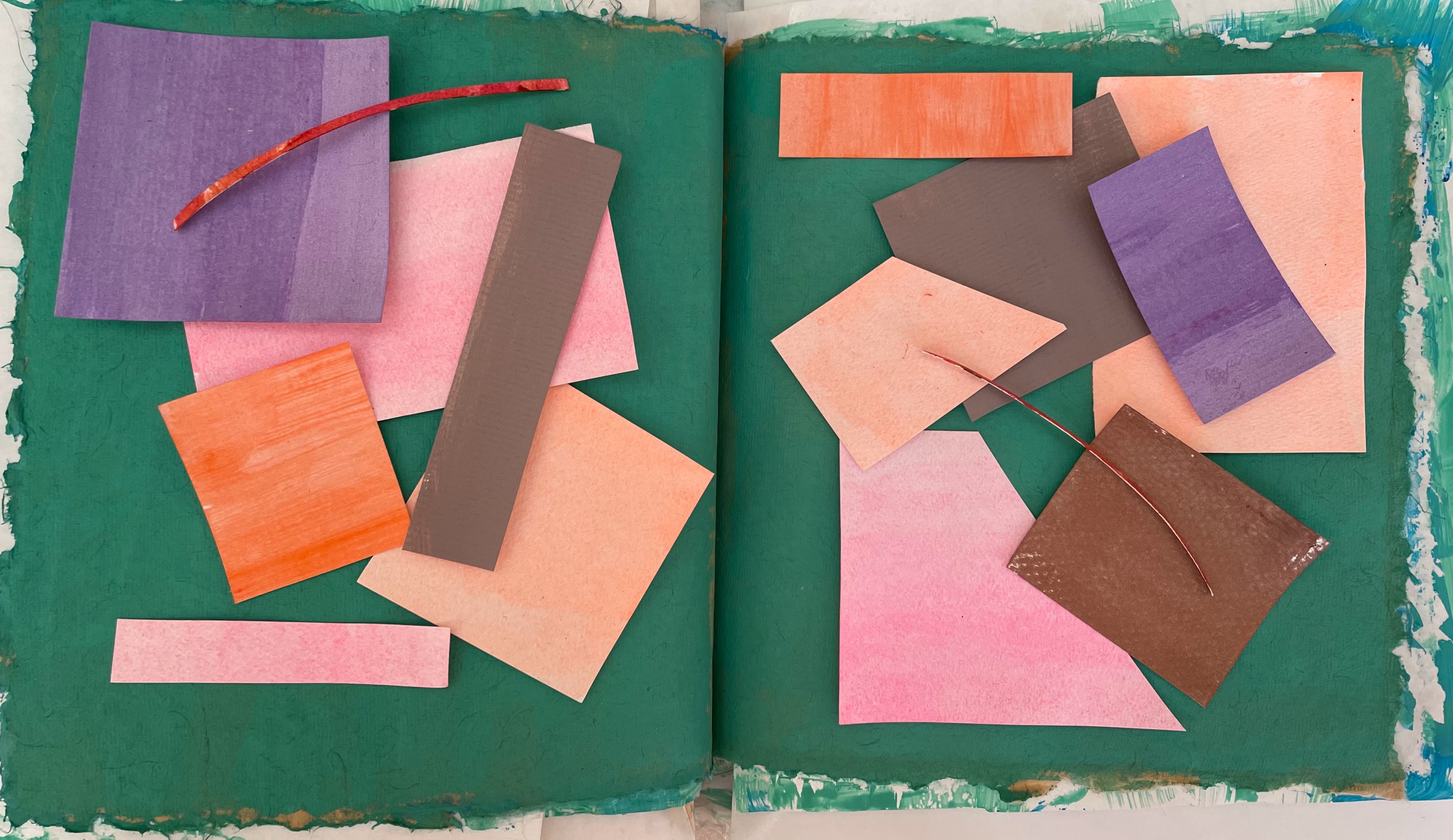
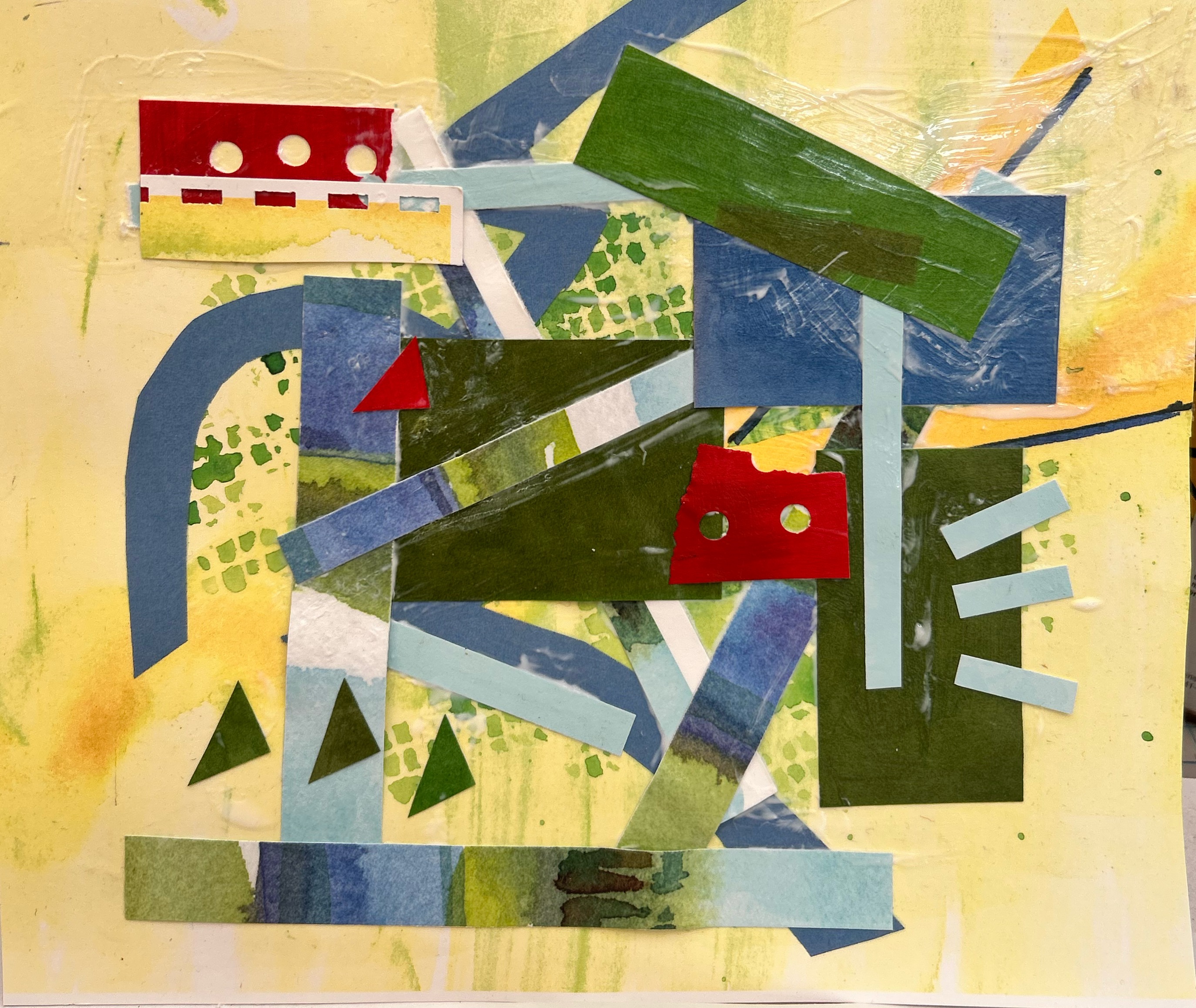
Back in the studio. This summer I cleaned out boxes and boxes of old calendars that were gifts from a friend. I hated to throw them away, so I took them out to the studio. I’m enjoying the dialogue between my friend’s art and mine.
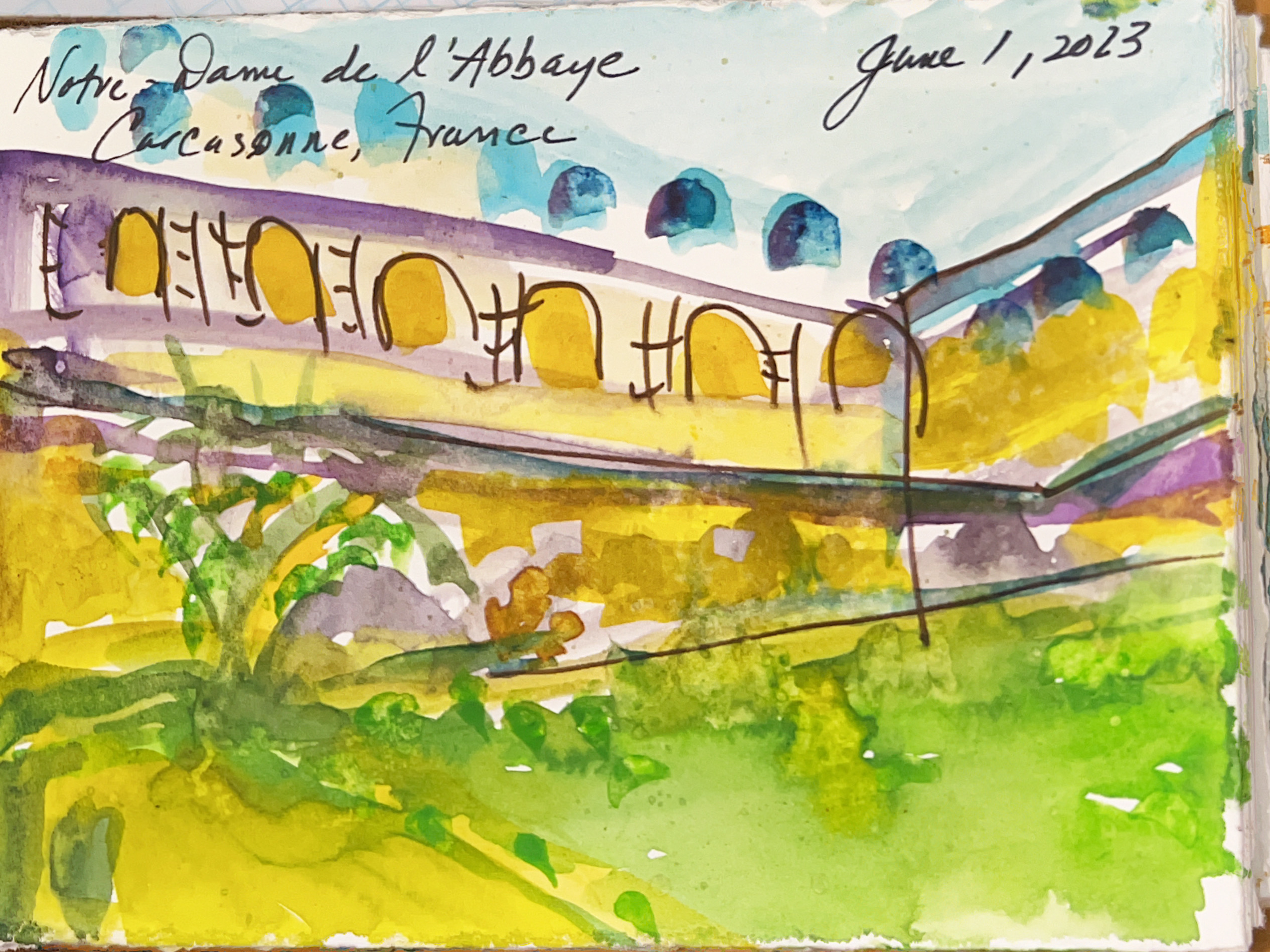
I did a few quick sketches from my trip to France and I’m going back and using watercolor to finish them.
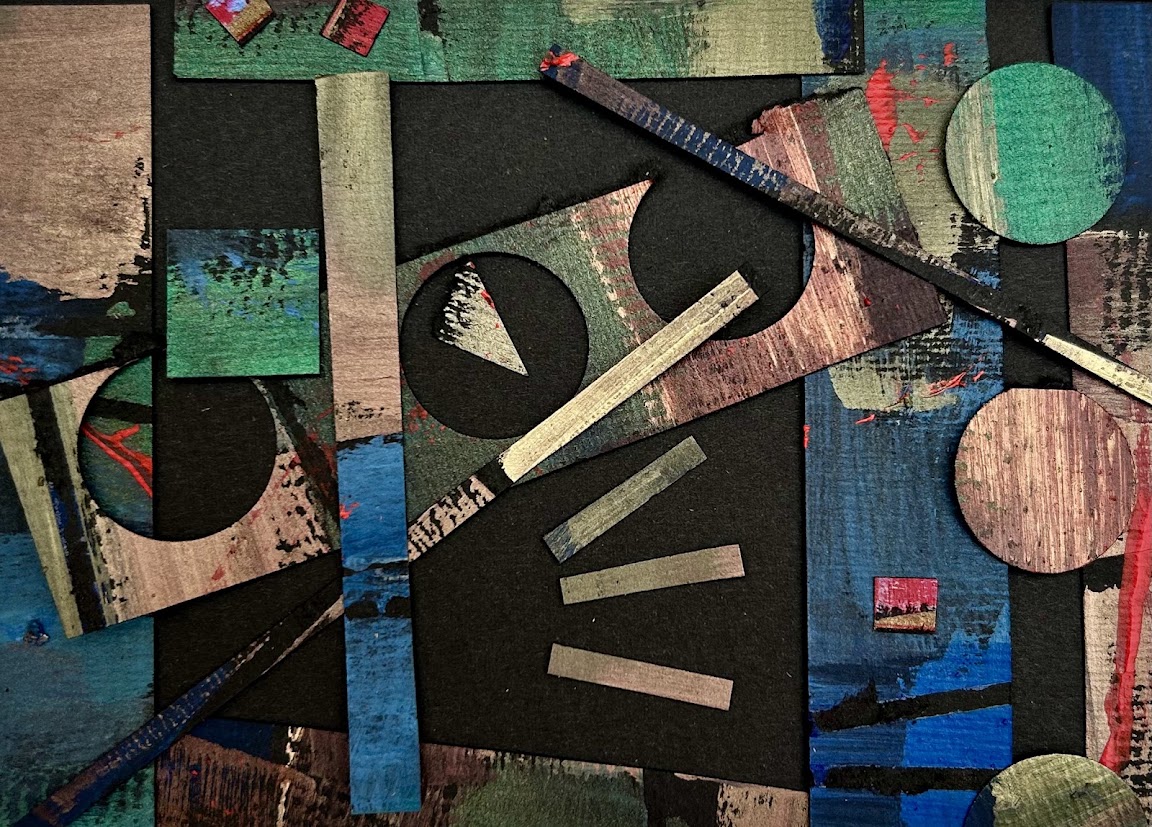
For this series, I’ve cut up and reassembled elements from earlier work and placed them on black paper. I have not glued them down as yet, but I’m close to committing.
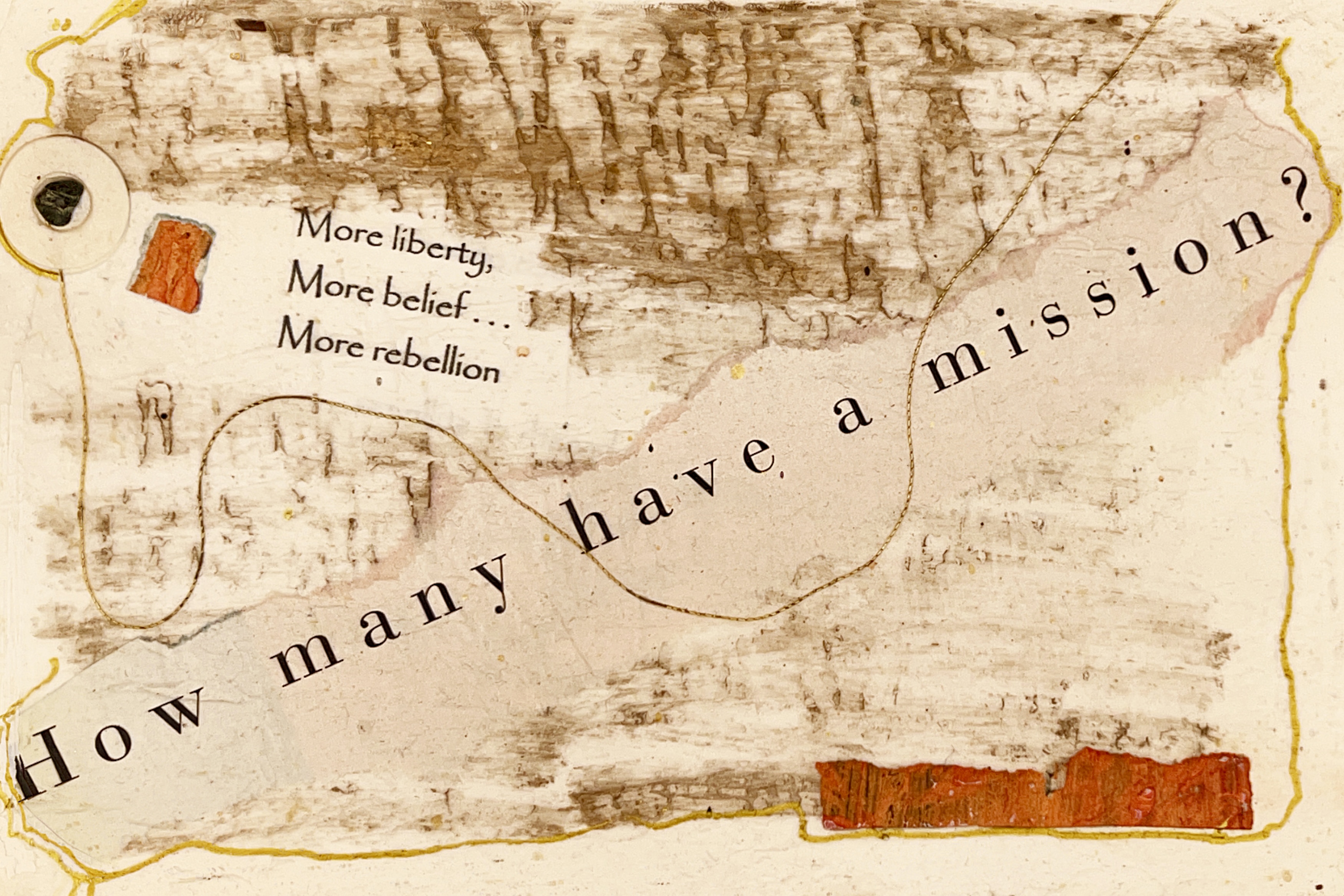
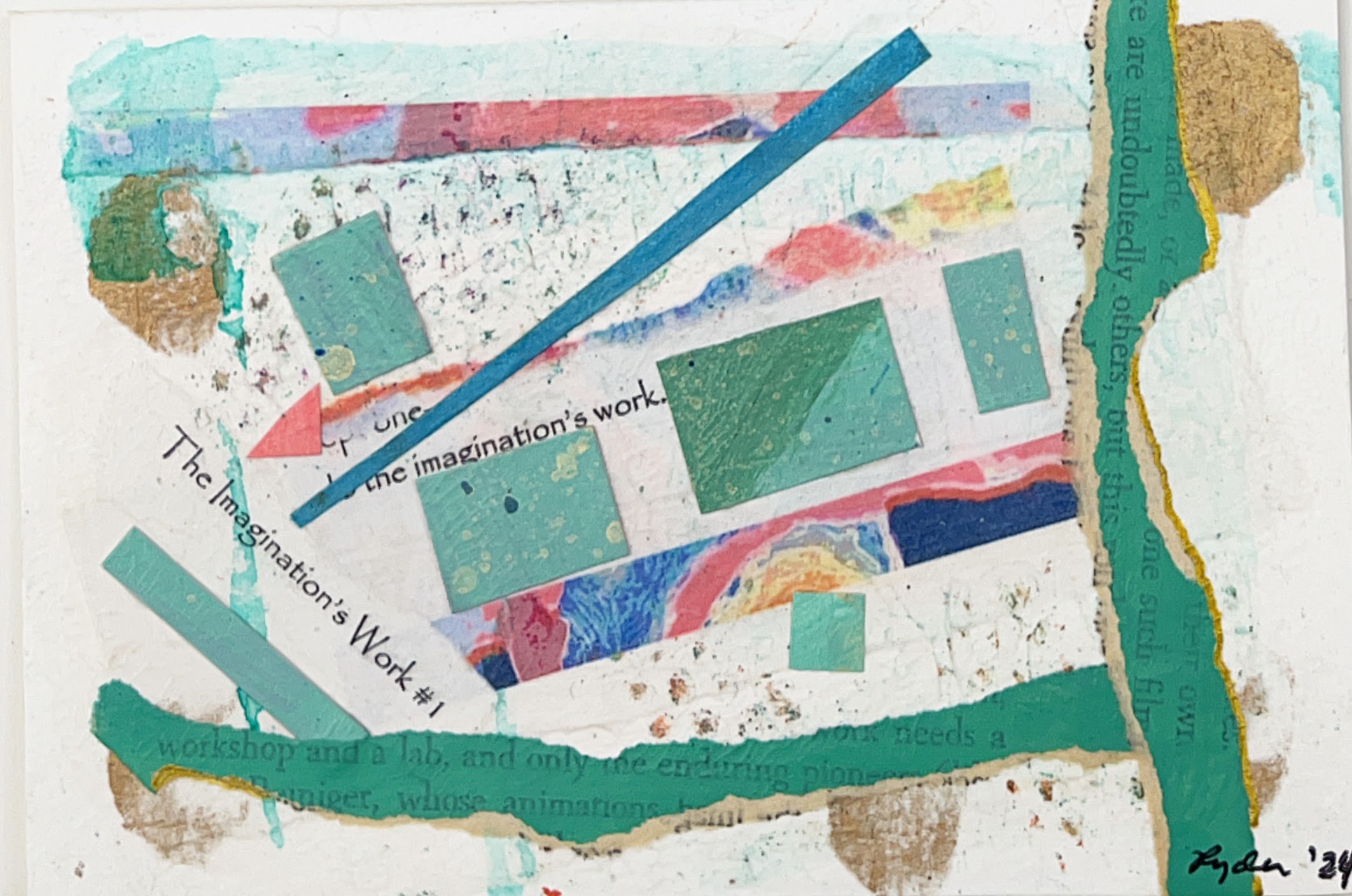
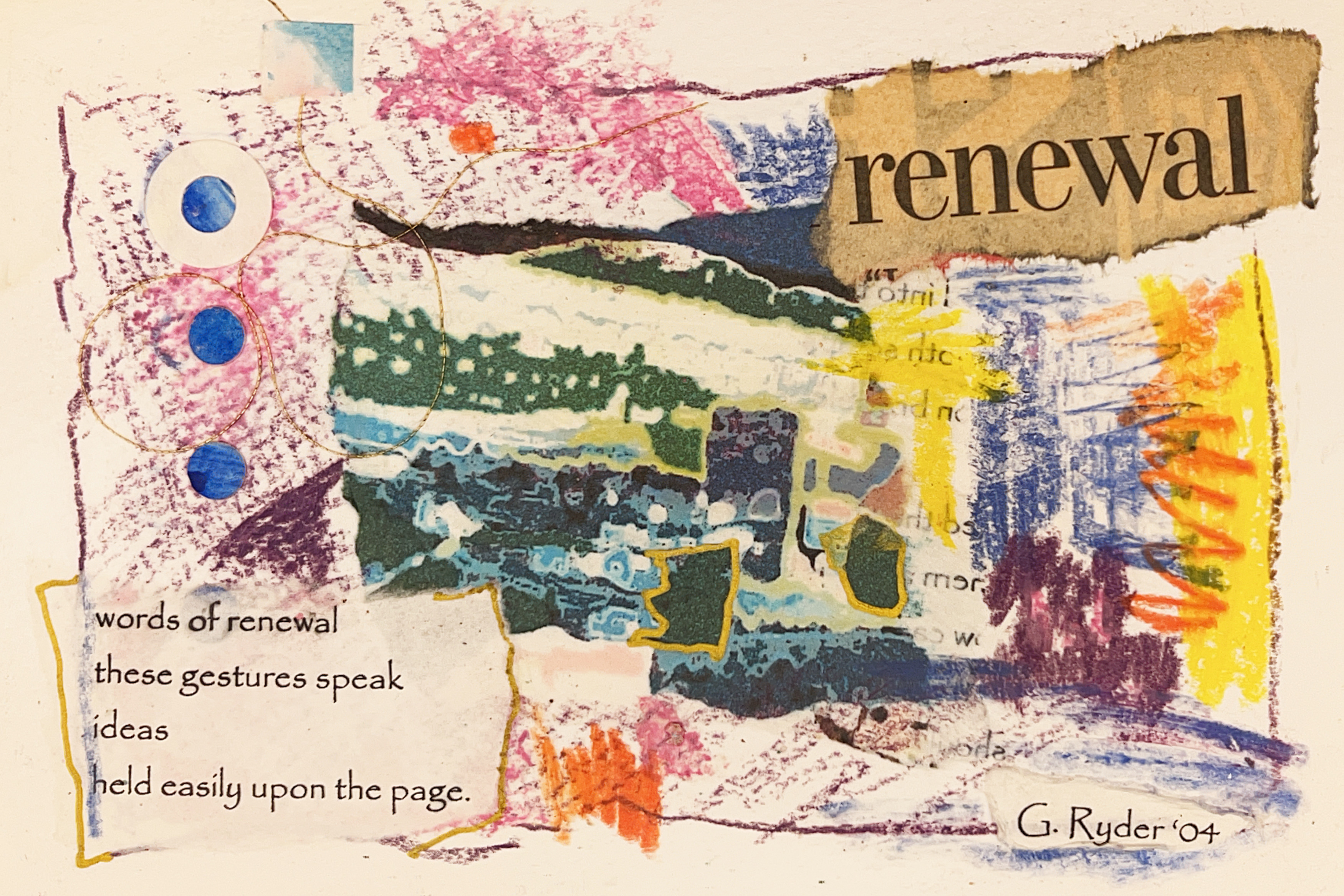
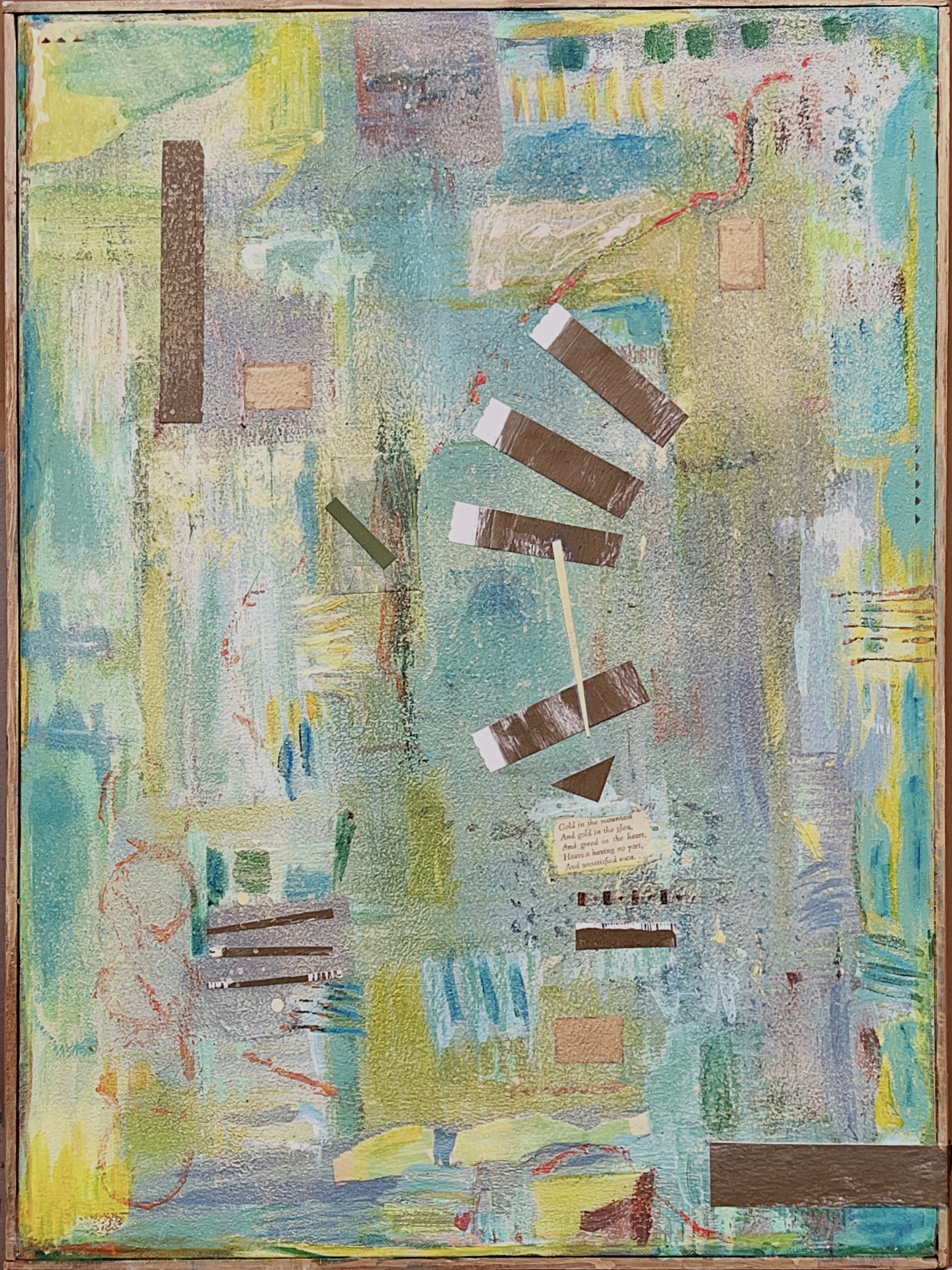
I spent the last few days trying to translate the work process that I was satisfied with back in 2022. I want to move from paper, collage, and mixed media to canvas. “The Life of Poetry” continues.
I grew up in the last half of a century of civil wars
waged in diners, schools, and voting booths.
Three bodies pulled from an earthen dam in Neshoba County.
I was 15.
Picking blackberries along the red dirt ditch,
Highway 17 was gravel then.
Watching the fireflies, I lay on my grandmother’s quilt, the damp ground
seeping into my sunburned skin.
Listening to the muffled grownup voices,
Trying to sleep, but far too awake.
I grow old in a new century of civil wars.
2.20.24
“Writing is only another way of giving, a courtesy, if you will, and a form of love.” Muriel Rukeyser
My multi-media project hit a long pause as I transitioned from working on the visual work to responding and being inspired by her poems, specifically, her collection of poems published under the title, Out of Silence.
This first draft is my poem in response to Rukeyser’s “The Poem as Mask” from The Speed of Darkness (1968).
The Poem as Mask
When she wrote about Kirkegaard and the Sunshine Supermen,
it was a mask.
When she swam in the hidden quarry, naked, splashing with joy,
it was a mask.
When she wrote of goddesses, gold-trimmed, ethereal maidens, singing songs of exile,
it was just her celebrating
but unable to sing.
There is no starlite, hidden quarry, no goddesses, only a memory of our divided lives.
The poet, “split open,” she wrote. Yes.
Two children, one scar.
Now, the goddesses raise their butterfly hands, joining them to make their own music.

How to Write a Poem
The words arrive
assembling themselves
on the tattered, Persian carpet in the center of the grand ballroom.
Anxiously, they await the poet.
Tapestries of silk cover each wall,
Large, dark paintings in gilded frames climb high, one above the other
Portraits wait still and frozen for the poet’s arrival.
Velvet drapes keep the dawn’s sunlight at bay
Large ropes curl around them
From a distance, footsteps echo down the long marble hallway.
The double doors thrust open,
curtains stir,
Their velvet ropes fall to the floor
A faint must rises as they settle on the marble; the poet is here
The words scatter to the edge of the room
The poet enters; sunlight pierces the drapes–falling across the floor in narrow bands.
Words gather at the center of the room,
Lining up on warp and weft. . .
A poem appears, the poet studies the portraits, turns to leave,
Pausing, she breathes in the spirit, pausing to listen,
knowing what comes next.
This is a link to the Muriel Rukeyser book that I “deconstructed” for my art journal project: https://www.themarginalian.org/2020/12/14/muriel-rukeyser-the-life-of-poetry-in-crisis/